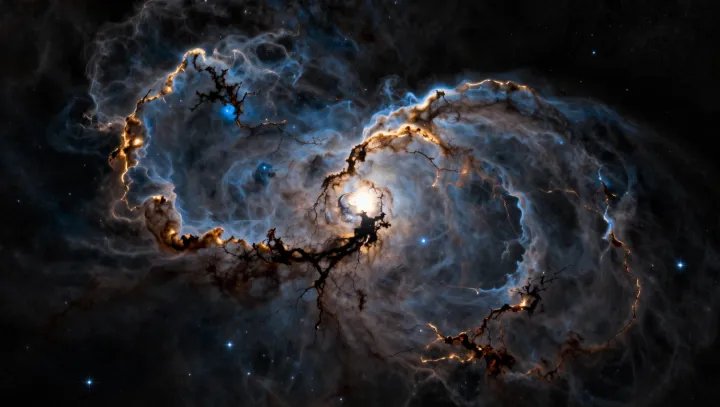
The void lies. Along a luminous nebula, a black seam seems to erase the stars behind it, yet that apparent vacancy is a dense screen of interstellar dust, placed between an emitting field and the observing eye. Ionized gas may shine around it, which makes the interruption seem sharper. What looks like nothing is an accumulation.
The deception is physical. Individual grains, made largely of silicates and carbon-rich compounds, absorb and scatter starlight; together, their optical extinction raises the column density along a line of sight until visible radiation is cut down. A camera records the deficit. Because shorter wavelengths are attenuated more strongly, surviving light can appear reddened, a clue to grain size and composition rather than ornament. Radiative transfer, not visual emptiness, governs the result.
The darkness is therefore productive. Infrared observations can penetrate portions of the cloud that optical light cannot cross, while radio spectroscopy of molecular gas can expose structure within the same obscuring material. The contrast matters. Dark lanes often mark cold, dense regions where gas and dust collect, conditions associated with star formation, though the shadow alone does not prove that a star is being born. In a nebula, a lane can separate emission from reflection, making geometry as informative as composition. The image leaves an odd reversal: its deepest black is evidence of abundance, not loss.