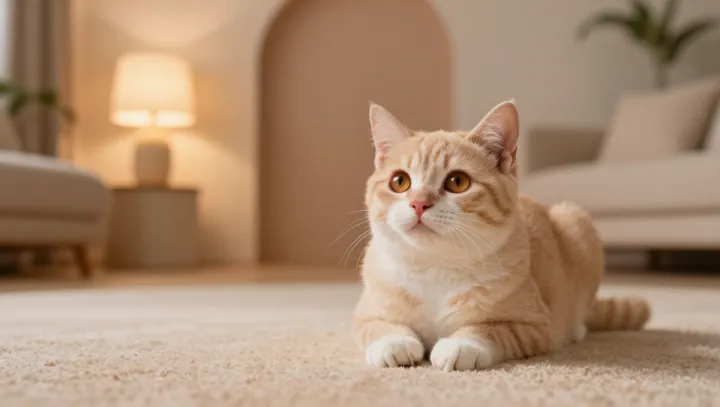
That stare is no daydream. A kitten's face, tipped toward a dim ceiling or a faint shuffle behind a chair, frames eyes built to collect scarce photons rather than idle thoughts. The pose sells innocence. Its vision stays on duty.
The cute reading is backwards. A kitten's large eyes admit more available light, while a retina rich in rod photoreceptors responds when illumination falls and contrast thins across an indoor room. This is not mysticism. Low-light sensitivity trades crisp visual detail for detection, a sensible exchange for an animal whose attention is often pulled by prey-sized motion rather than a static outline. That trade is deliberate. A drifting dust mote, a curtain edge, or a hand moving beneath a table can seize attention before a stationary toy does. Your kitten is scanning.
Do not mistake stillness for calm. Behind the lifted chin, pupil dilation and the tapetum lucidum support low-light vision, though this visual apparatus favors a change that breaks the room's pattern over fine detail held perfectly still. The bargain has limits. Colors and sharp form yield ground to motion detection, especially where light is thin. It is an ambush sensor. You see a dreamy face, but the kitten may be measuring flickers near the floor, where a small moving target matters most. Would you notice it?