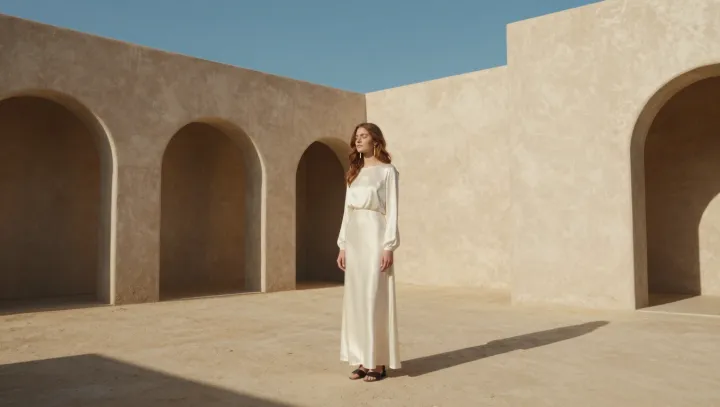
White is fashion's least forgiving luxury. Under direct light, a plain dress turns every decision into evidence: the density of its weave, the opacity of its lining, the fall of a side seam, and the exact distance between waist and hem. Nothing decorates the mistake away. Even a slight pull reads loudly.
The expensive part is often discipline, not ornament. Cut on the grainline, cloth either hangs with composure or twists around the body; dart manipulation must shape volume without announcing itself, while seam allowance and lining construction decide whether the silhouette survives movement. No camouflage exists. A busy print can scatter attention; white directs it, almost cruelly, toward fiber length, yarn twist, and finishing. The eye registers contrast before it grants praise, so shadows at the bust or hip become a quiet audit of patternmaking. Buyers may call that effect purity, but it is closer to inspection.
That judgment carries a peculiar irony. The dress that appears easiest to make asks for the fewest excuses, because proportion becomes visible before style has time to make its case. A low-cost cloth can imitate color. It cannot easily imitate a clean neckline after hours of wear, or a skirt whose drape returns to order after a chair, a stair, and a turn. White offers no alibi. That scrutiny is what customers pay to avoid. In the final stillness, the garment either holds its line or reveals the bargain.