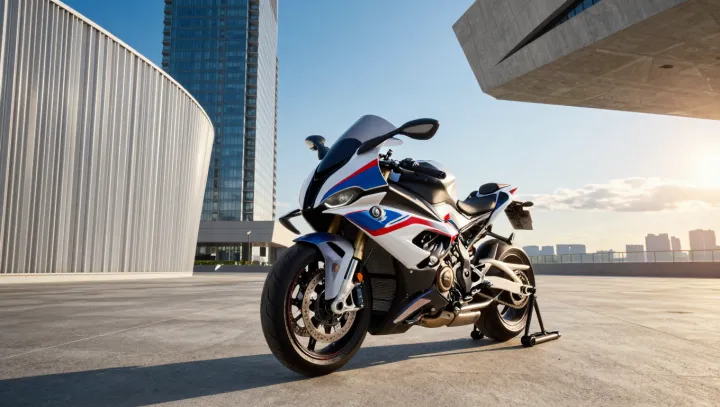
The nose tells on them. BMW sport bikes wear fairings that seem drafted rather than sculpted, with tight seams, hard creases, and compressed volumes recalling a glass-and-concrete facade. That is deliberate. At speed, a fairing manages airflow around the rider and chassis; its frontal area, vents, and edge radii are constrained by drag coefficient, boundary-layer behavior, cooling demand, and the need to keep the machine stable when turbulence begins to bite.
That kinship is no accident. Modern architecture and a track-bred motorcycle share an unforgiving premise: every line must justify itself, whether it directs rain from a roof or separates air before it turns chaotic across a fork, radiator, and rider's knees. Speed dictates the drawing. BMW's angular panels therefore read as structural even when they are bodywork, because packaging density forces mass inward while aerodynamic load and heat rejection force openings, lips, and channels outward. The result feels urban. It borrows the city's grammar without surrendering the circuit's demand for measurable control.
The city completes the argument. Against traffic, storefronts, and rectilinear towers, the motorcycle does not look misplaced; it looks like a mobile fragment of the same design culture, one shaped by computational fluid dynamics but legible at a curb. Nothing here is soft. Yet apparent severity serves motion rather than monument: a parked bike holds its pose, while the air it was drawn to cut remains invisible, impatient, and already gone under conditions no street corner can fully disclose.