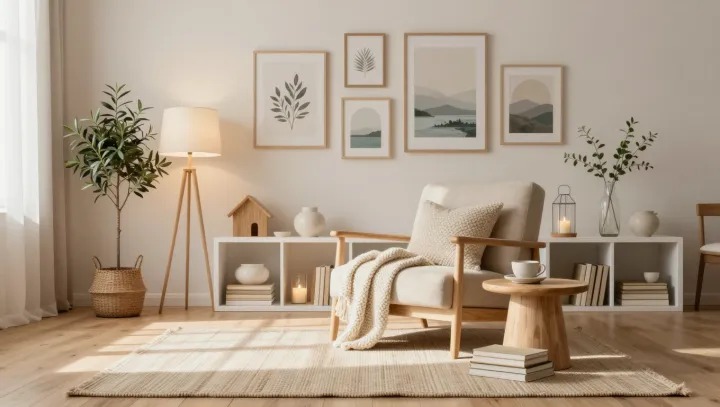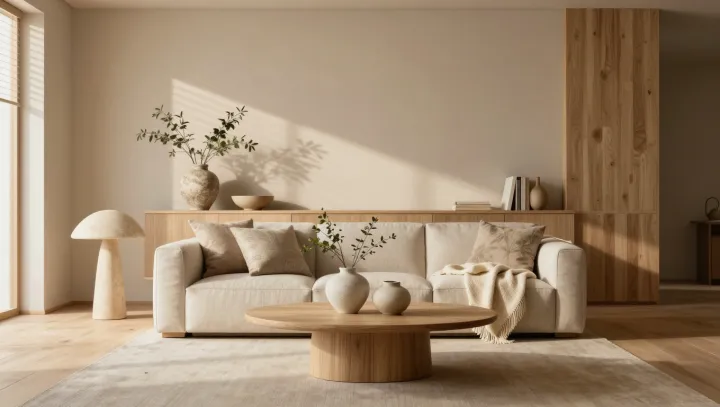
A wool throw, a limewashed wall, and sunlight caught in oak grain can make a sparse room feel more hospitable than a showroom crowded with objects, because the eye reads variation without being forced to sort competing messages. The effect is real. Texture supplies microcontrast, small shifts in roughness, reflectance, and shadow, that keep attention gently occupied while leaving the room's spatial hierarchy legible. Blankness need not feel bare.
Decoration often loses this contest. A dense collection of polished frames, patterns, and ornaments creates high visual complexity, yet it also raises cognitive load as figure-ground segregation becomes less certain and each item asks to be identified. Natural materials behave differently. Their irregularity offers perceptual fluency: grain, weave, stone veining, and matte variation register as a coherent field, so the brain can sample detail without continually reassembling the scene.
Warmth, then, is less a matter of acquisition than of perceptual mercy. Restraint wins here. A room with fewer objects can let daylight travel across grain and fiber, producing soft luminance gradients that imply use, age, and touch without turning every surface into a claim for notice. Not abundance but legibility makes the invitation. At evening, an almost empty room may hold the eye the way a quiet fire holds a dark window: by giving it just enough to stay.