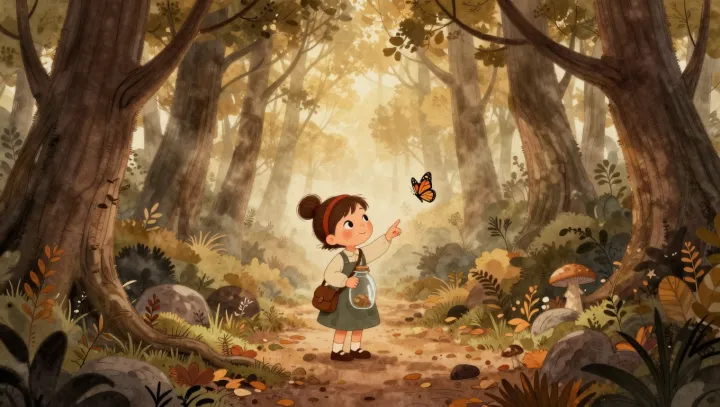
Softness is editorial. Where a field observer would register wingbeat, contrast, and escape behavior, a softened image lowers edge acuity and suppresses the visual cues that make an insect seem quick, exposed, and contingent. Time loosens its grip. Slowed motion stretches temporal integration, allowing each flutter to read less as locomotion than as gesture; the butterfly is no longer merely seen, but staged as a tiny character under a lamp.
Rounded movement persuades too easily. Curved trajectories and eased animation borrow from the infant schema: minds commonly link smoothness, symmetry, and gentle acceleration with vulnerability and safety, even when the subject is a wild animal whose life depends on abrupt correction. The trick is perceptual. Low spatial frequency lighting removes sharp texture and hard shadows, while reduced motion rate weakens the signals of biological motion that announce alertness, pursuit, or flight. That is the bedtime bargain. Reality has not changed, yet its visual grammar has: danger fades into hush, and observation becomes a story asking to be held rather than studied.
Calling this innocent would be naive. Such treatment does not falsify the butterfly so much as select from it, privileging duration over urgency and contour over anatomy, until a camera's choices begin to carry the emotional authority of a nursery illustration. Framing does the rest. With the background emptied and the wing kept central, attention abandons taxonomy for narrative expectation; viewers anticipate pause, comfort, and return, not predation, weather, or exhaustion. That is its quiet power. At the edge of the frame, an animal remains free, while the eye makes it small enough for sleep.