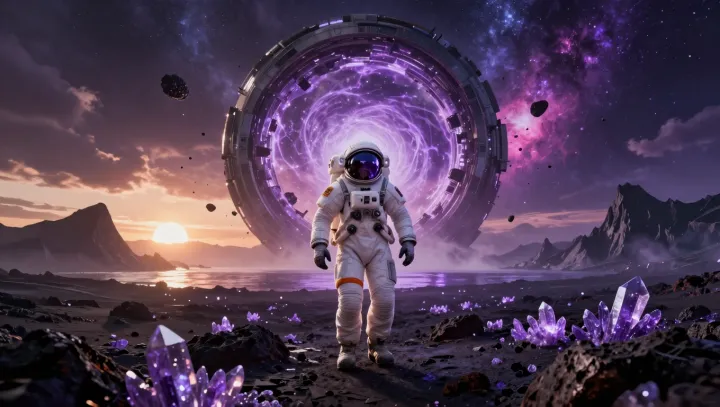
The ring hangs there, neon-bright, against black. That image cheats physics: empty vacuum has no emissivity, so no photons are generated along a circular path unless material such as plasma is heated, excited, or scatters incoming radiation. Cinema hides the bill. A visible boundary must either emit light through processes such as thermal radiation or fluorescence, or redirect light that already exists.
Lensing is the exception. When a massive object lies nearly on the line between a distant source and an observer, spacetime curvature can bend that source light into an Einstein ring. Alignment does the trick. Gravitational lensing changes the paths and apparent positions of photons; it does not make empty space luminous, and the ring vanishes when the geometry breaks. The image is borrowed. The familiar case needs a compact lens and a source placed behind it, while the observer sits close to the optical axis.
That difference matters. In radiative transfer, intensity needs an emitter, a scatterer, or a background source; vacuum alone supplies none of these. Think display pixels. Like a GPU shader, plasma emission turns supplied energy into visible output, while lensing remaps existing light; a spacecraft that built the effect would need power, optics, and matter, not a tear in space. Hardware sets limits. As imaging systems and field control improve, the most convincing artificial portal will be an engineered light machine whose physics remains visible beneath the spectacle.