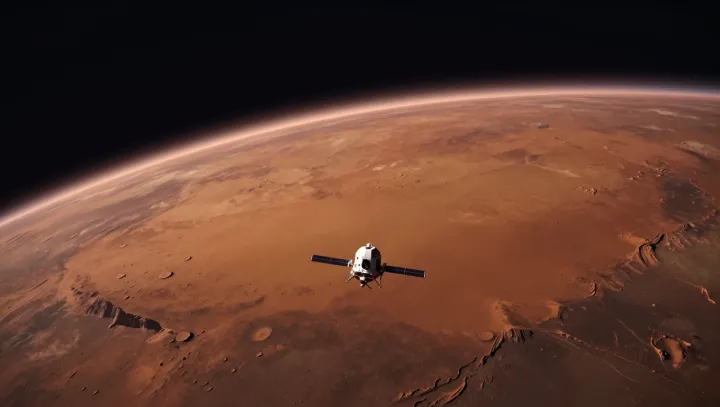
Thin light punishes waste. At Mars, daylight delivers less than half Earth's solar energy, while dust, cold, and distance from the Sun narrow a craft's margin. Solar missions endure because power is treated not as a steady supply, but as a rationed and predicted resource.
Panels buy time. Designers enlarge photovoltaic arrays, select efficient cells, and orient the vehicle so its incidence angle favors available sunlight; the extra area must still fit launch limits and survive deployment. Margins vanish fast. A power budget assigns every watt to heaters, radios, and instruments, while timed activity protects battery reserves. Dust collects relentlessly. Planners reserve capacity and may wait for wind to clear part of a panel surface.
The clever part is restraint. Maximum power point tracking, or MPPT, adjusts voltage and current so an array operates near its strongest electrical condition. Voltage is negotiated. Like a voltage auctioneer, MPPT samples changing output from panels and chooses the combination that yields the most usable power. Cold tests chemistry. Lithium-ion batteries absorb daytime surplus and release it overnight, but charge cycles, temperature limits, and state of charge require firm control.
Storage decides the night. When seasonal sunlight drops or dust darkens the sky, flight software enters low-power modes, shuts down secondary loads, and wakes only for heating, communications, or timed observations. Silence saves watts. That discipline makes the craft an autonomous energy trader, choosing minute by minute without ground commands. Autonomy changes scale. Better onboard forecasting could stretch scarce photons across longer silences and support bolder work between them.