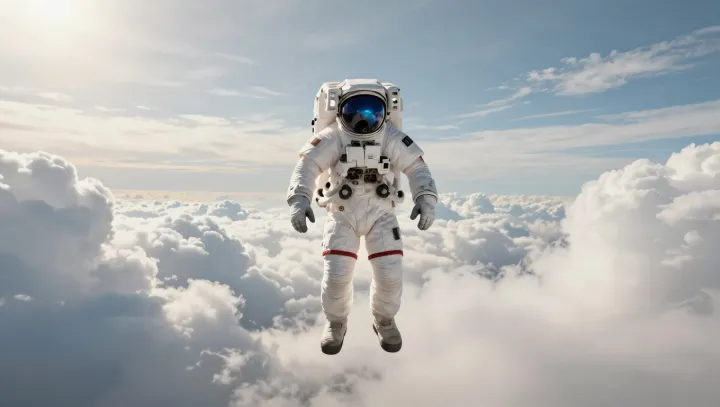
A blue arc below an orbital window makes a stubborn lie look plausible: above the clouds, an astronaut seems to have left the atmosphere behind. Not so. Air does not meet space at a clean border; density falls through the thermosphere and exosphere, while scattered molecules persist beyond the weather below.
The popular explanation is backward; gravity at station altitude remains strong enough to govern every turn, even though the air there is so sparse that ordinary weather has ended. Speed changes everything. A craft moving at orbital velocity follows a ballistic trajectory whose continuous free fall bends around Earth, because centripetal acceleration matches the planet's curvature instead of carrying the vehicle straight into the ground. Microgravity is shared motion, not absent gravity. Crew, tools, and cabin fall together, so no surface supplies the normal force that the body reads as weight. Cloud tops mislead badly. They mark the troposphere's visible drama, not the atmosphere's outer reach; above them sit the stratosphere, mesosphere, and thermosphere, each thinner than the last. Air still invoices a cost. Residual molecules produce atmospheric drag, slowly draining orbital energy and demanding reboost maneuvers; the Karman line, often treated as a gate, is only a convention within a gradual transition. No clean exit exists. In the window's blue arc, flight becomes a strange bargain: the farther the traveler seems from Earth, the more plainly Earth writes the terms.