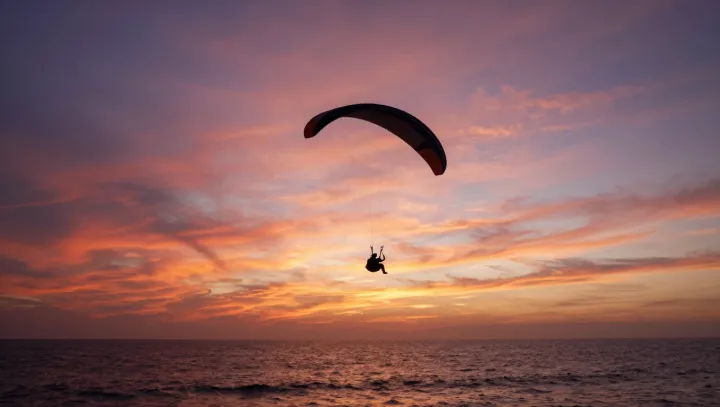
Amber light lies. As the sun drops, a canopy holding a pilot at steady airspeed can make gravity seem to loosen, because the body reads changes in acceleration more loudly than it reads a sustained load. Nothing has vanished. Lift, produced by a pressure differential around the airfoil, still carries much of the pilot-wing system's weight.
The real trick is inertia. Once the wing settles into coordinated flight, its glide path changes gently enough that the vestibular system has little fresh acceleration to report. The harness keeps talking. It spreads the remaining load across the body, while a far horizon offers sparse visual references and fails to broadcast the wing's forward speed. That calm can deceive. Continuity sells the illusion. True weightlessness requires free fall, where support force disappears; here, the canopy and harness provide it continuously, just without abrupt changes. The distinction matters. The sensation is closer to riding an elevator at constant speed than to falling, though the comparison ends when changing air begins to push back. A paraglider is not suspended; it converts altitude into motion, its glide ratio shaped by airspeed, brake input, and airmass.
The air still decides. Often, cooling near sunset weakens convective thermals, so the ride can feel smoother, although local wind, rotor, sink, and terrain can quickly end that bargain. Steady is not safe. The wing needs continuous relative wind, and a pilot who mistakes sensory quiet for stillness can miss a turn, a gust, or a descending air mass. Below the fading light, the machine remains obedient to gravity, even when the body argues otherwise.