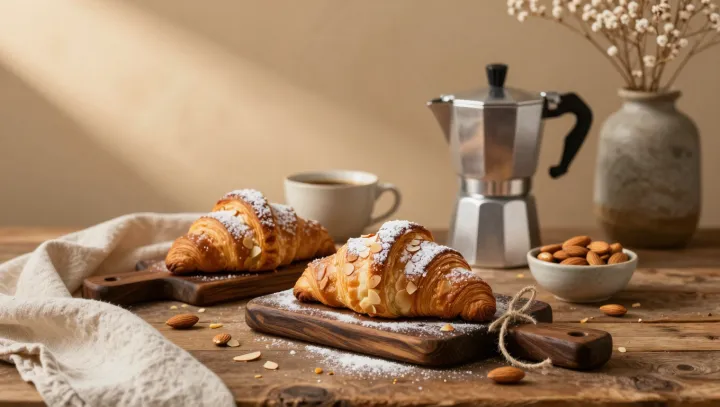
Powdered sugar catches on the croissant's ridges, while the butter-browned crust seems to deepen beside it. The heat is imaginary. Nothing in that white veil raises the pastry's thermal energy; instead, vision reads the pale grains and amber crust as a contrast pair, making the gold appear richer and, by association, newly baked.
Context runs the show. In simultaneous contrast, a light, nearly neutral surround can push an adjacent yellow-brown surface toward a denser, warmer appearance, especially under the visual system's color-constancy calculations. Those calculations try to discount illumination, not to measure a croissant like a thermometer. Against white, the toasted crust gains saturation in the eye's estimate. Sugar also signals a finishing touch, and learned links between browned pastry, butter, and oven heat supply the rest.
The effect is small but commercially potent: food images live or die by cues that announce freshness before appetite has sampled a crumb. A dusting alters luminance, edge sparkle, and expectation, not temperature. Yet the pastry, motionless on its plate, can look as though it has only just left the oven--proof that the eye often tastes a story before the mouth does.