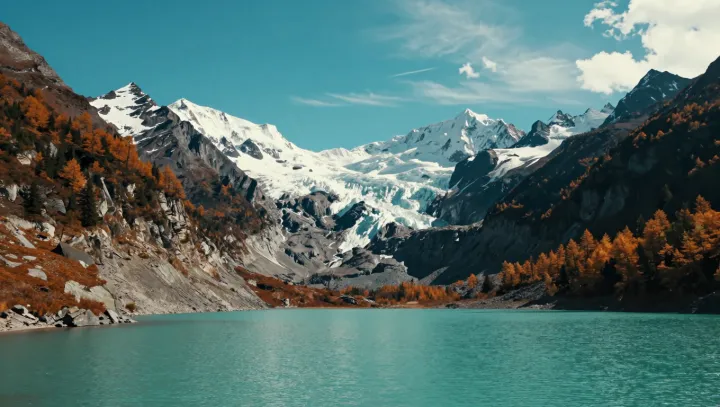
Sunlight strikes suspended silt, and an apparently blue basin begins performing a small optical trick: glacier-ground mineral particles redirect selected wavelengths toward the eye rather than allowing the lake's darkness to swallow them. The effect looks implausible. Yet it is ordinary radiative transfer, staged in water so cold that the color can seem almost invented.
The famous hue is less pigment than negotiation. Rock flour, the powder produced by glacial abrasion as ice drags stones across bedrock, can remain suspended because its grains are exceptionally small; those grains scatter incoming light through Mie scattering, sending much of the blue and green portion back upward. Red light loses. Water itself absorbs longer wavelengths more readily, so the reflected mix can shift from pale blue toward turquoise when sediment concentration, grain size, depth, and sunlight align.
That beauty has a hard edge. Add too much sediment and the water becomes milky gray; remove the particles and a deep lake may read as dark blue, green, or nearly black, depending on its bottom and surroundings. Turquoise is therefore not a permanent lake color but a brief bargain among ice, crushed rock, clear water, and light. At the shore, the glacier's violence appears almost gentle.