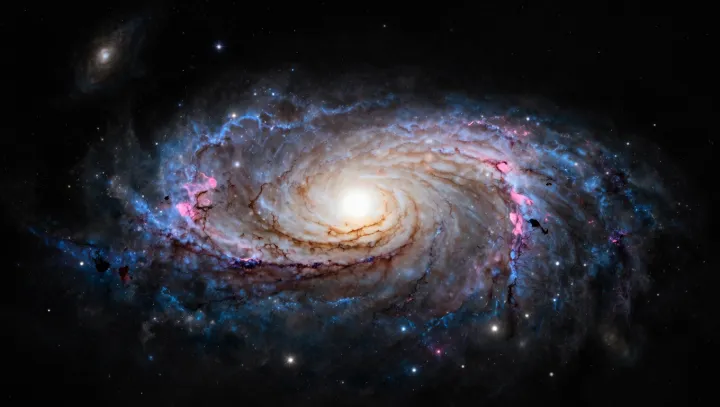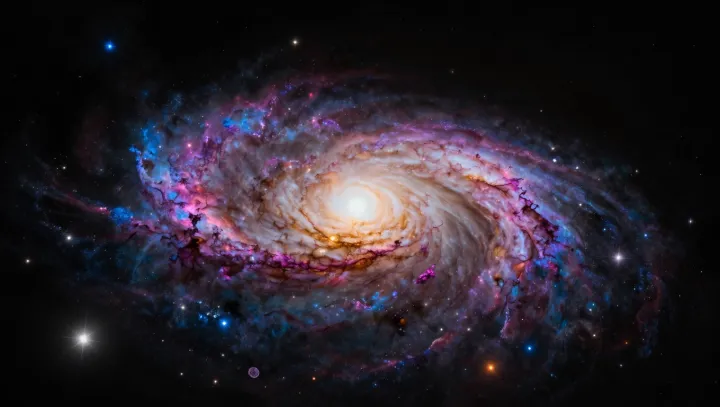
The arms do not merely decorate the disk; they expose a city under pressure. Across the spiral, blue knots of young stars puncture lanes of gas and dust, while gravity gathers matter into arcs that look composed only because the violence is organized. Order is temporary.
The calm is deceptive. Gravity supplies the architecture, but gas makes it visible: as material enters a spiral arm, compression can seed molecular clouds, whose collapse produces luminous, short-lived massive stars. Those stars heat and ionize nearby gas; winds and supernovae then return energy to the interstellar medium, slowing some collapse even as they can trigger it elsewhere. Differential rotation complicates the picture. Inner material circles faster than outer material, so an arm cannot simply be a fixed string of the same stars. Density-wave theory offers one explanation for persistent patterns, while transient arms may arise through gravitational instabilities and interactions. This is not a static portrait. It is a record of orbital motion, feedback, and renewal, written in light that keeps changing long before the eye notices.
The sharper wonder lies in the mismatch between appearance and process. A spiral galaxy earns its quiet appearance by distributing upheaval across distances too large for instinct to grasp. Its glowing arms are neither ornament nor route map; they are episodes in a long gravitational argument, briefly lit by stellar birth and partly erased by stellar death. From afar, the disk holds its pose. Within it, nothing is holding still.