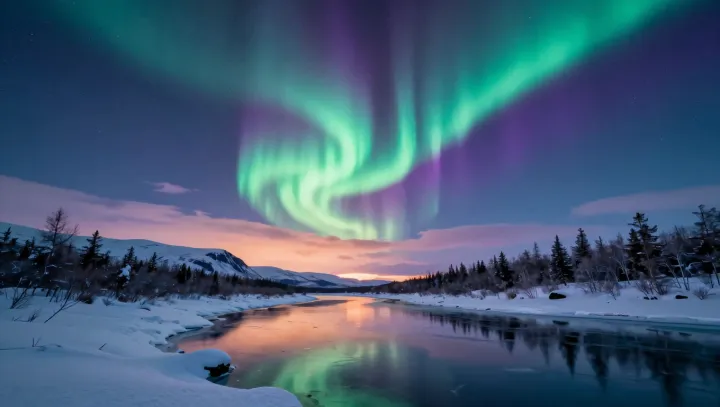
The magnetosphere is no heater. Green ribbons can flare overhead while ice stays hard because the aurora spends its energy far above the surface, where thin air offers little route for warmth to travel downward. The particles arrive. Think of the magnetosphere as a packet router: it channels solar electrons and ions along magnetic field lines into polar skies.
That is the trick. At roughly 80 to 500 kilometers up, collisions excite oxygen and nitrogen; when those atoms and molecules relax, they emit photons at auroral wavelengths. Photons stream outward. Most incoming particle energy instead becomes ionization, molecular motion, and local heating in the thermosphere and ionosphere, where the air is too rare to pass much heat toward the dense lower atmosphere.
This is no furnace. Even strong particle precipitation deposits energy high overhead, while ordinary solar radiation heats the surface far more directly during daylight. Snow never gets the memo. As satellite sensors fuse particle measurements with ionospheric models, aurora forecasts could become a live map of space weather power routing, showing where the sky will burn with color while the ground remains cold.