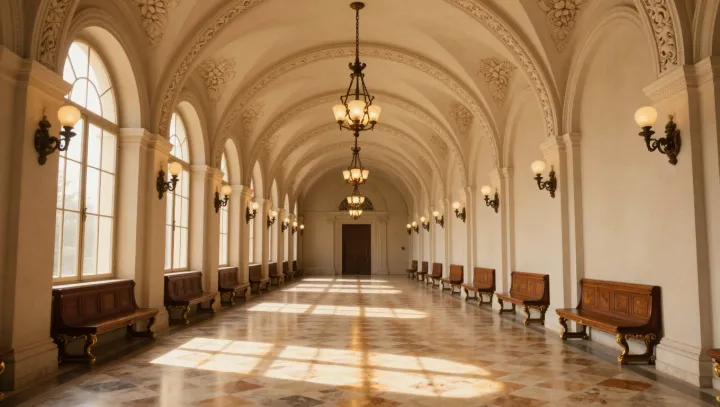
Daylight lands on one arch, then another, breaking a long hall into a sequence of framed intervals rather than a single tunnel. That is the trick. The eye reads recurrence as order, while the shifting bright and shaded bays make distance feel legible instead of oppressive.
Grandeur, oddly, depends on limits. An arcade supplies a steady spatial frequency: columns and curved openings repeat at intervals the visual cortex can predict. Predictive coding lowers the burden of surprise, and regular saccadic eye movements give attention small destinations. The hall still recedes, but it recedes in beats. Each bay becomes a manageable unit, so the visitor senses progression rather than exposure. This is not mere decoration. Repetition also creates a hierarchy of scale; the body measures itself against a local arch, then gathers the accumulating rhythm into an impression of collective size.
Light does the softening. Daylight introduces luminance gradients that separate planes, reveal curvature, and prevent the far end from collapsing into visual monotony. Where glare is controlled, peripheral vision detects both shelter at the sides and prospect ahead, a pairing often linked to comfort in environmental psychology. The result is an architectural bargain: order steadies the nervous system, while recession enlarges the imagined field. At the vanishing point, the hall seems less like a corridor than a promise held in light.