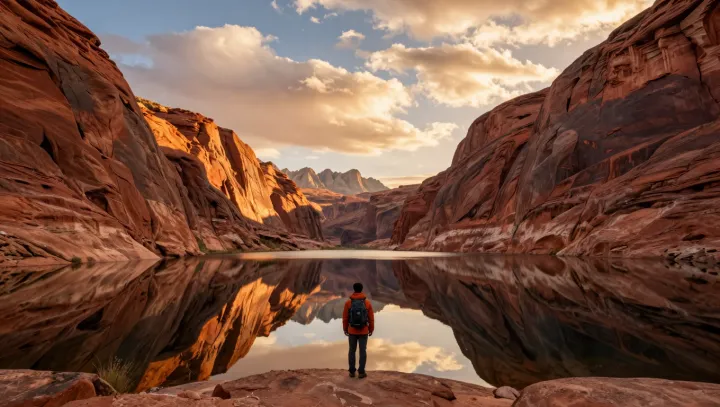
The pool performs a quiet fraud. At sunset, a glassy water surface returns rays by specular reflection, so each point on a cliff is mapped into a virtual image beneath the surface; the peak appears inverted not because it has moved, but because the eye reads reflected light as coming from below. No mountain budges.
Distance is the casualty. A broken, wind-ruffled surface supplies motion, glare, and disrupted texture, each a depth cue; a mirror removes them and stitches shore, cliff, and image into one continuous plane. It also suppresses the texture gradient that normally tells vision how terrain recedes. The brain dislikes blanks. Through cue integration, it can treat the doubled scene as nearer and more compact, especially when the far bank offers few objects of known size. Perspective does not fail. Perception reweights its evidence.
Height suffers a related trick. At low solar angles, the bright sky and darker land sharpen the reflected contour, while the waterline becomes a persuasive horizontal reference. Sunset makes the bargain more convincing, because oblique illumination exaggerates tonal separation and can hide small surface ripples from a viewing angle. With no visible gap beneath the cliff, the visual system may assign less vertical separation to the summit, making it feel lower or closer than the same slope on dry ground. The effect is strongest in calm water; ripples scatter light and restore discord. A mountain, briefly doubled, becomes an argument against trusting a clean horizon.