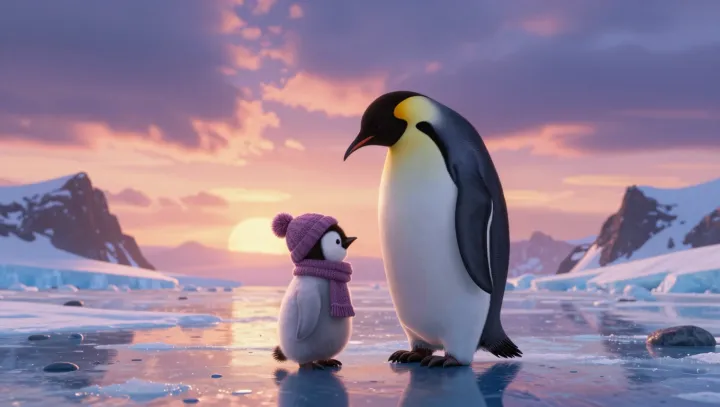
Blue-white light catches on a bowed head and two bodies pressed close, creating the kind of frame viewers call tender before they have asked what it shows. A penguin has become, in an instant, a parent from a human drama. That reading is ours.
The mistake is instructive. Gestalt perception turns posture, proximity, and timing into a social whole, while anthropomorphism assigns a private motive to movements that may carry no such message; pareidolia helps convert a cluster of feathers and flippers into an embrace, complete with a face we think we recognize. The story arrives first. Evidence limps after it, because the brain favors rapid pattern completion over patient ambiguity when an image offers only a few cues. This is an efficient inferential shortcut, one that lets social life move at speed.
The penguin is not a blank screen. Field ethology can test behavior against breeding status, pair-bond maintenance, colony pressure, thermoregulation, chick protection, and food exchange, separating observable function from the inward feeling viewers invent. Motive remains hidden. Such tests depend on repeated observations and comparisons, not on the emotional voltage of a single photograph. A lowered head may accompany care, vigilance, fatigue, or simple positioning; without context, certainty is performance. The arresting part is not that people see love in a bird. It is that a quiet bird can make the human mind confess how eagerly it writes dialogue for silence.