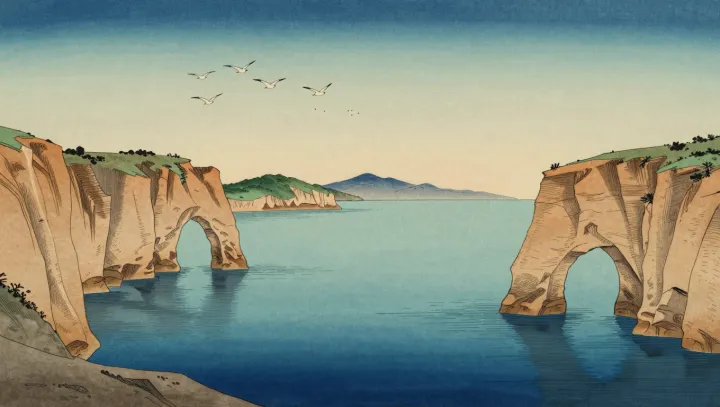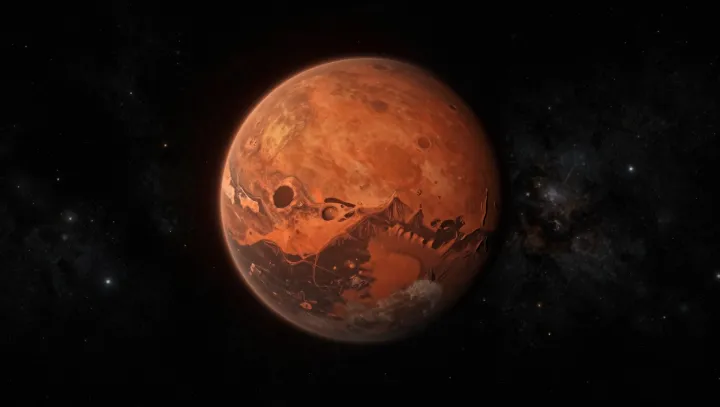
The calm is cosmetic. Along a canyon wall, sunlight catches stacked strata and fault scarps, while a nearby crater holds a raised rim, ejecta, and a broken floor; in that close frame, Mars reads less like a frozen desert than a file of damage left open for inspection.
Valles Marineris indicts Mars. Crustal extension, tied to the loading of Tharsis, opened fault-bounded blocks, after which landslides, wind abrasion, and perhaps ancient water reworked the exposed rock. This was no single rupture. The scale forces a correction: Mars is not an inert sphere marked by accidents, but a crust that repeatedly yielded under stress, exposing material from depths that ordinary erosion rarely grants a camera.
Craters do not forget. Impact excavation begins when hypervelocity collision drives shock waves through bedrock, throws ejecta beyond the rim, and can leave breccia and impact melt behind. Their later fates matter. Some basins were softened by sediment, altered by erosion, or invaded by lava, preserving not merely the blow but a long argument between burial and exposure. From orbit, Mars is a disk; inside each shadowed wall sits motion, arrested but not erased.