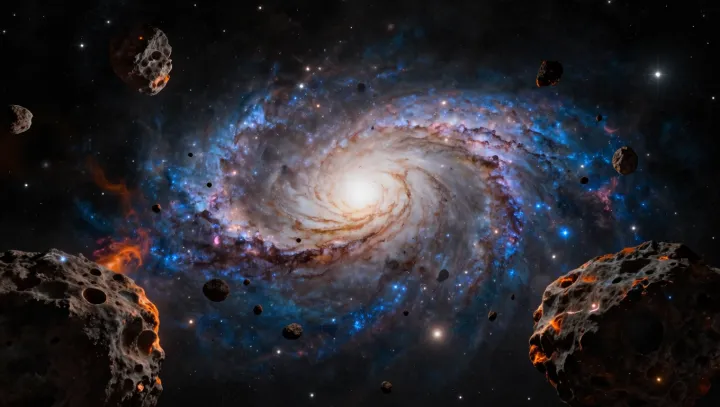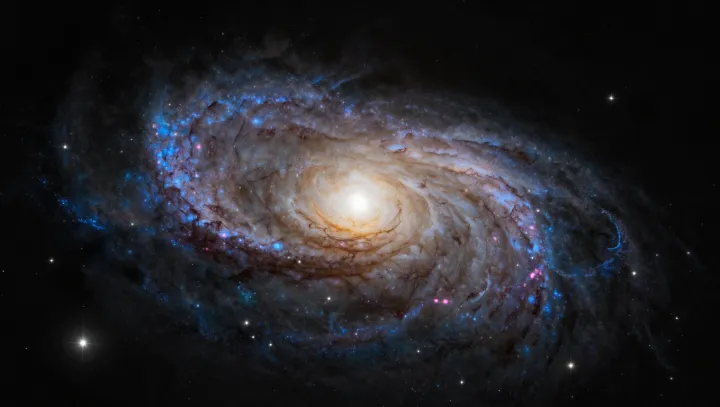
The visible pattern is deceptive. Against the dark disk, blue light gathers along curved lanes while stars stream through them at different orbital speeds; not a road, then, but a traffic jam shaped by a density wave. The image persists. Differential rotation makes the mismatch unavoidable, because matter nearer the center completes an orbit sooner than matter farther out, continually overtaking the pattern.
That distinction matters more than the postcard view suggests. A spiral density wave creates a changing gravitational potential, compressing interstellar gas as it passes and triggering star formation; massive young stars, brief-lived and bright, then advertise the arm before their orbits carry them onward. Gravity sets the terms. Near corotation resonance, exchanges of angular momentum can preserve or reshape a pattern, while bars, tidal encounters, and transient instabilities can generate arms with different lifetimes and forms.
The galaxy is less a drawing than a recurring argument between order and drift. Epicyclic motion sends stars oscillating around guiding centers, and self-gravity can amplify slight overdensities until distant observers read a durable curve across the disk. No star needs to stay. What remains visible is a repeating concentration of matter, gas, and newborn light, refreshed as the disk rotates and erased only to form again elsewhere. The arm holds its pose; its actors never do.