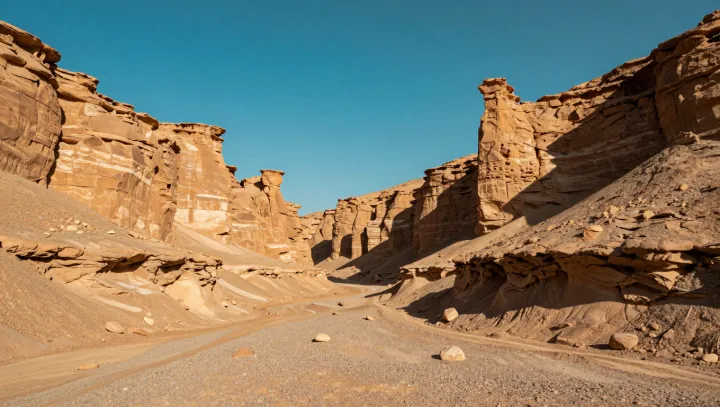
The cliff face deceives. Beneath its sun-struck crust, a thin runoff thread can enter a joint, exploit a fracture plane, and, through hydraulic action, turn a barely visible seam into a channel that steals stone from the wall. Wind gets the credit. Yet fluvial incision often cuts farther, because sediment-laden water grinds by abrasion, while repeated wetting and drying weaken grains at the channel margins.
Water is the patient aggressor. Where storms concentrate flow above a cliff, runoff gathers into rills and gullies; each pulse transports sand and gravel, lowers the channel bed toward its base level, and leaves the surrounding rock increasingly unsupported. Gravity finishes the argument. Blocks detach when undercut slopes lose support, widening canyons whose apparent stillness masks a cycle of infiltration, erosion, and collapse. The lesson is awkward. A desert cliff is not merely polished from outside; it is hollowed along its weaknesses, as water turns rare storms into cumulative work.
Wind is the loud decoy. Aeolian deflation can lift loose grains and scour exposed surfaces, but it seldom concentrates shear stress as confined flow does, directing energy into narrow pathways rather than spreading it across the face. That difference remakes scale. At dusk, the dry wall keeps its silence; every recess records an absent stream, and the canyon reads less like a monument than a ledger of pressure, particles, and patient loss.