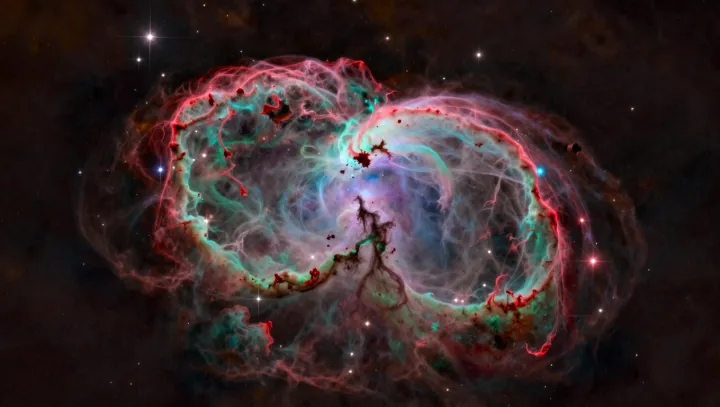
The familiar band deceives. Across a moonless sky, its pale grain seems to lie on a distant ceiling; instead, it is the inside view of the Milky Way's galactic disk, seen nearly edge-on, where hundreds of billions of stars are compressed by perspective into a luminous seam. The apparent streak is geometry, not structure.
The error matters. Only from within the disk could a vast rotating system look so thin: nearby suns, remote clusters, spiral arms, and the central bulge are stacked along a single sightline, their distances erased by glare. Were the galaxy viewed face-on, its stellar populations would spread into a broad wheel rather than a stripe. No single ribbon exists. What seems continuous is an optical census, not an object suspended above Earth.
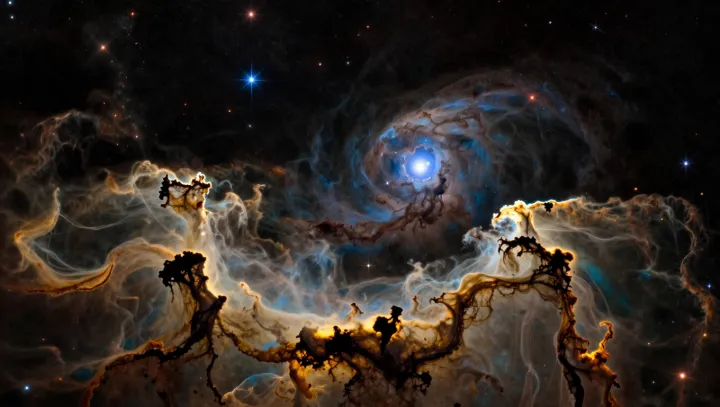
Dust is the stern editor. Interstellar extinction, caused by grains that absorb and scatter optical light, carves apparent gaps through the galactic plane and conceals stars behind it; infrared observations can reveal sources whose visible radiation does not arrive. The dark lanes are evidence, not emptiness. Our night sky is a partial record, a side-on ledger whose missing entries shape the story as much as its light.