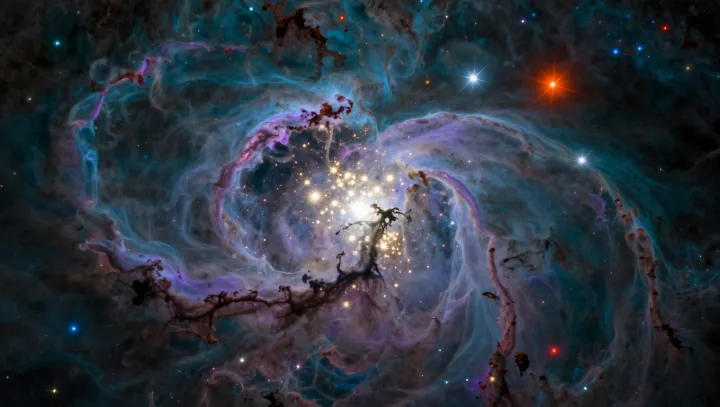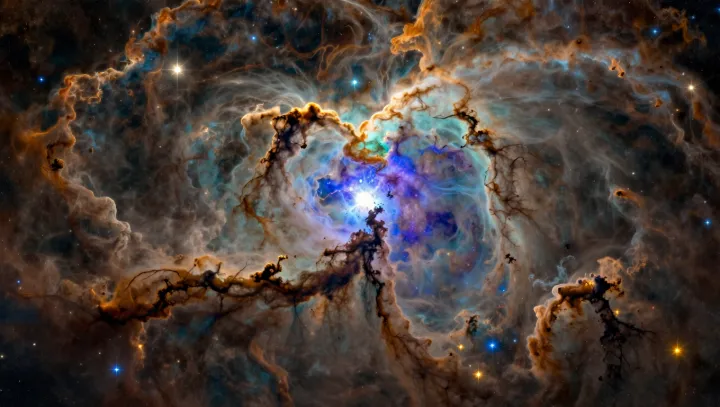
Red is the giveaway. Across a cloud 6,000 light-years away, ultraviolet photons from hot, massive stars hammer hydrogen atoms, ejecting electrons and converting a cold-looking gas bank into an ionized emission nebula whose visible output crosses interstellar space as red light. The ultraviolet itself remains beyond human sight; its aftermath does not.
The mechanism is ruthless. In photoionization, photons in the Lyman continuum carry enough energy to strip electrons from neutral hydrogen, leaving protons amid a charged plasma; when free electrons later drop into lower energy states, hydrogen recombination emits discrete wavelengths, including H-alpha at about 656 nanometers. Spectrographs separate that line from starlight and dust-scattered glow. Its strength can also track the rate at which ionized gas recombines. Nothing burns there.
The cloud is a delayed dashboard. Hydrogen recombination acts like a server background process: photoionization logs the ultraviolet input, while H-alpha emission reports the reset when electrons rejoin protons, letting astronomers locate massive-star radiation and estimate how it sculpts neighboring gas. Distance adds the eerie constraint, because the red photons show conditions from 6,000 years earlier rather than the cloud's current state. It is not a postcard; it is a diagnostic signal with a long delivery delay. Sharper instruments can convert these red traces into finer models of star formation, gas loss, and radiation feedback.