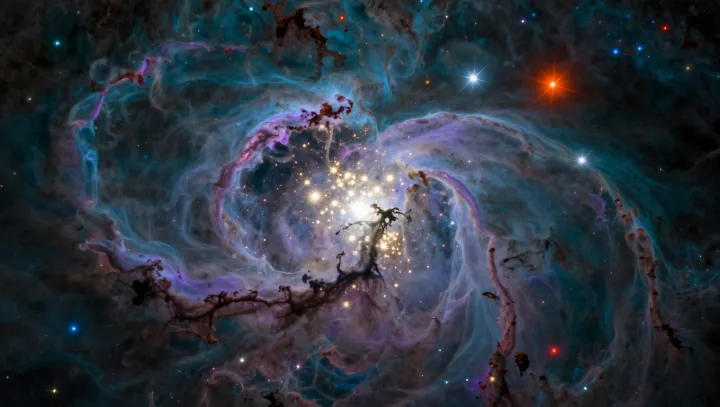
Brilliance carries a cost. In this stellar nursery, massive stars are stripping away the gas from which more stars could form, turning the conditions of their birth against their potential successors. Light becomes an eviction notice. As ultraviolet radiation heats surrounding material and stellar winds drive it outward, the cloud loses some of the cold, dense reserves that gravity needs.
Brightness can deceive us. Although glowing gas makes a nursery appear lavishly supplied, much of that visible emission comes from material exposed to radiation rather than from the coldest reservoirs where stars take shape. The distinction is physical. Through photoionization, energetic photons remove electrons from atoms, heating gas that can expand away from exposed cloud surfaces and escape smaller concentrations of material. Winds add mechanical force. Streams of particles from massive stars transfer momentum to their surroundings, sweeping gas into shells and opening cavities whose apparent emptiness records the work of stellar feedback.
Destruction is not uniform. Where expanding shells press into surviving gas, compression can encourage gravitational collapse, provided the material becomes dense enough and is not dispersed before gravity takes command. Context decides the outcome. The same stellar population can therefore suppress star formation in one pocket while helping it begin elsewhere, complicating any simple account of a nursery shutting down. Not every fragment survives. Beneath the glare, the nursery's unfinished stars depend on whether their remaining darkness can hold.