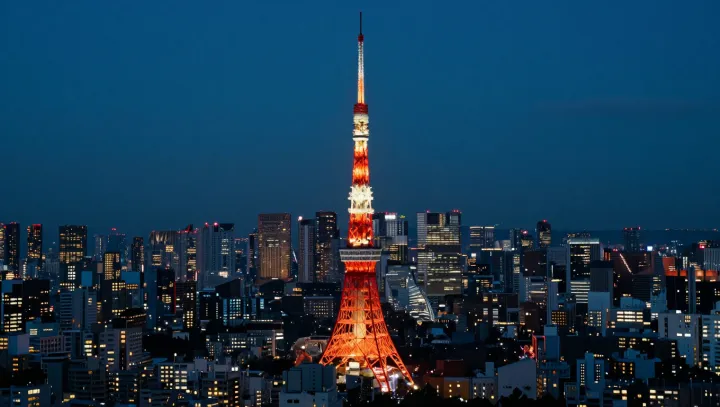
The red point wins. A red lamp near a tower's crown, isolated against a dark field, can command the eye from blocks away because distance does not erase contrast at the same rate that it thins radiance. The inverse-square law cuts irradiance fast, yet a dark background gives the remaining photons almost no competition.
Contrast beats raw power. Red is not automatically brightest: in full darkness, it can look weak because rods respond poorly to long wavelengths. Yet city nights usually produce mesopic vision, where rods and cones share the task and opponent-process channels separate saturated red from gray clutter. It changes sorting. In signal-detection theory, the lamp acts like a priority packet on a congested network: chromatic contrast and target-background ratio lift it past the detection threshold.
Height does the rest. When the fixture clears roofs and trees, its line of sight stays open while nearer streetlights are screened, scattered, or absorbed by walls. The tower need not look large. A tiny angular size can still register if luminance contrast survives atmospheric extinction and the source remains spatially isolated. Add a steady outline or slow flash, and temporal summation lets the eye collect evidence across successive moments. Cities may treat nighttime visibility as an information-routing problem, not a contest of watts.