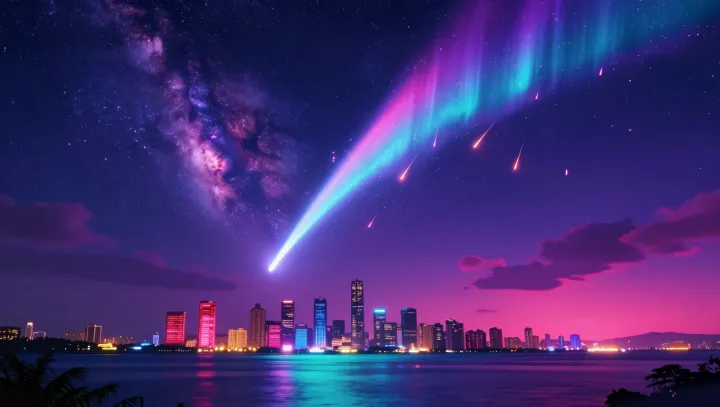
The flash is no trick. You are watching a small rock cash an absurd velocity check as it strikes the upper air. A meteoroid can arrive at roughly 11 to 72 kilometers per second. Fast. Because kinetic energy rises with the square of speed, even pebble-scale mass can dump energy at a rate that briefly overwhelms the skyglow below.
The air is the real furnace, and that is why the size comparison misleads. Ram pressure compresses gas ahead of the body while ablation strips and heats its surface. Not friction alone. The compressed gas, vaporized minerals, and fragments become plasma; ionization then produces glowing atoms and molecules. Much of the visible light comes from this hot wake, not from a rock burning like firewood. A fast, dense grain can therefore make a compact fireball, especially when its path is high overhead and its light reaches you through less murky air.
City glare is not invincible. You do not need darkness to see a meteor whose peak luminosity rises far above nearby skyglow for a fraction of a second. Contrast, not size, decides the contest. A shallow approach can stretch the event across more sky; a head-on plunge can concentrate energy into a shorter burst. Composition matters too: iron-rich material and volatile minerals can alter ablation and color. The show ends almost at once. Would you notice the next one before your eyes return to the streetlights?