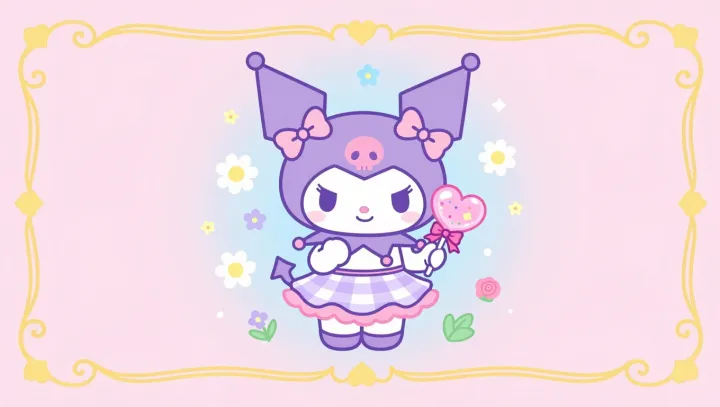
Flowers make better accomplices. Rather than taming Kuromi, a floral border gives her black hood, pointed ears and pink skull motif a sweeter setting against which their punk-inspired attitude becomes more pronounced. Softness supplies the friction. Where petals suggest delicacy and decorative order, her angular silhouette seems to interrupt the arrangement, making a familiar character look less obedient without changing her design.
The border does work. Through figure-ground relationships, an illustrator can separate a character from surrounding ornament, especially when pale blossoms sit beside a large area of black and their rounded contours oppose pointed shapes. Color matters, too. Pink flowers may echo Kuromi's skull emblem, creating visual continuity even as the contrast between gentle petals and dark headwear keeps the composition from becoming uniformly sweet. Harmony sharpens the disagreement. Instead of placing two unrelated styles together, the shared color gives them enough common ground for their differences to register as intentional rather than accidental.
Rebellion needs a foil. Against an equally dark, spiked background, Kuromi's styling would belong to its surroundings; among blossoms, those same details read as a refusal to fit the mood prescribed by the frame. That tension remains playful. The flowers do not establish anything about her behavior, but they encourage a reading in which cuteness and defiance coexist, each making the other easier to notice. Decoration becomes quiet provocation. Enclosed by petals, the little skull looks less like an accessory than a guest who has declined the dress code.