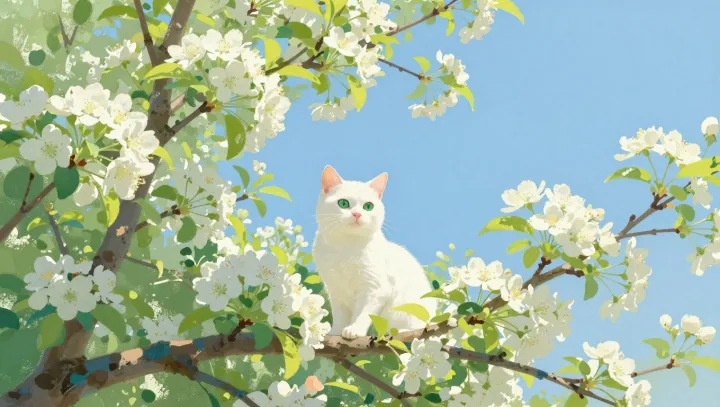
White need not betray. Although a white cat may stand out against green leaves, clusters of white blossoms can make its coat less distinct from the surrounding branches. Flowers complicate the picture. Where petals sit beside or overlap the animal, they can weaken the visual separation that would otherwise announce a head, a back or a tail.
The outline matters more. Background matching works when an animal resembles parts of its surroundings, while luminance contrast describes differences in brightness that can help an observer detect its edges. Color alone misleads here. Even though the tree remains mostly green, nearby white patches can reduce local contrast around portions of the cat, leaving fewer continuous boundaries for the eye to follow. Concealment is not guaranteed. A dark gap behind an ear may expose its shape, whereas a spray of pale flowers behind the same ear may make that boundary harder to distinguish.
Stillness buys the advantage. When the cat moves, changes in position can separate its body from stationary flowers, giving the observer information that a single motionless view does not provide. Distance changes the balance. Small details become harder to resolve farther away, although the effect depends on the observer's vision, the lighting and how much of the animal remains exposed. The disguise stays conditional. Shift the viewing angle, and the blossoms that softened the cat's outline may slip behind a branch, leaving a white shoulder suddenly legible among the leaves.