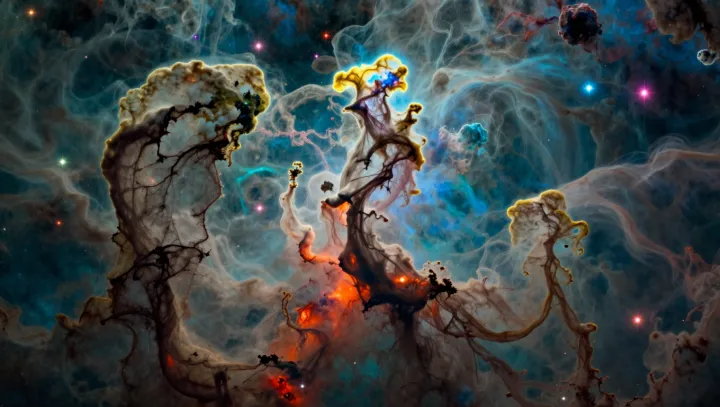
This mountain is disappearing. Hubble's Mystic Mountain, a pillar of gas and dust rather than rock, shelters forming stars while radiation and winds from nearby massive stars eat into its edges. Its grandeur is deceptive. Located in the Carina Nebula, roughly 7,500 light-years away, the structure rises about three light-years within a region where stellar birth carries its own demolition bill.
The apparent solidity misleads. What resembles a cliff in Hubble's image is a concentration of interstellar material, whose denser pockets can contract through gravitational collapse until protostars take shape inside their dusty cover. Gravity works behind cover. Dust absorbs visible light, concealing much of that activity, while narrow jets expelled by young stars mark places where star formation is already under way. Those jets betray construction. Driven by accretion and magnetic fields, they carry material away from growing stars, offering evidence that the pillar is neither an inert monument nor merely debris awaiting dispersal.
Protection comes with limits. Ultraviolet radiation from nearby massive stars heats and ionizes exposed gas, allowing it to escape through photoevaporation, while stellar winds help reshape the pillar's surface and remove material that might otherwise feed forming stars. The competition is unequal. Dense knots resist longer than their surroundings, but their survival depends on whether collapse proceeds faster than the loss of their surrounding gas, a contest the photograph cannot resolve by appearance alone. Beauty conceals that deadline. Beneath the sculpted outline, the same darkness that gives a young star shelter is being steadily opened to the light.