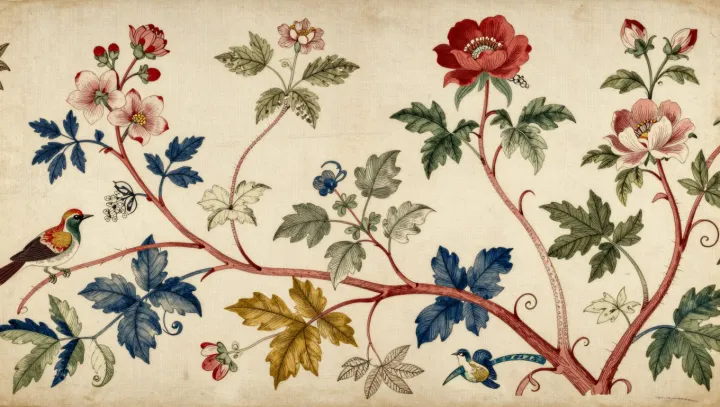
Brocade refuses the brush. Its intertwined birds and flowers emerge through the placement of decorative threads during weaving, rather than through pigment applied to an already finished surface. The distinction rewards attention. What appears at a distance to be a floral illustration is, close up, an arrangement of threads whose crossings produce both the image and its physical presence.
Structure deserves the credit. In many brocades, supplementary weft threads travel across the warp, the lengthwise threads held under tension on the loom, to form ornament above a separately woven ground. Those terms explain plenty. While the ground supplies the fabric's underlying cohesion, selected decorative threads pass over groups of warp threads before being bound into the cloth at chosen points. A petal takes shape. Repeated across the width, these controlled passages establish the edges of leaves, the curve of a wing and the places where stems seem to cross.
The surface resists flatness. Because decorative threads can float over the ground, their exposed lengths catch light differently as the cloth moves, giving a woven flower a presence that a printed outline alone cannot supply. The reverse offers clues. Depending on the weaving method, it may reveal carried threads or clipped ends, evidence that the ornament belongs to the cloth's construction rather than merely covering it. Looking becomes almost tactile. Held against the light, a bird remains suspended between two readings: an image the eye follows and a set of crossings the fingers could trace.