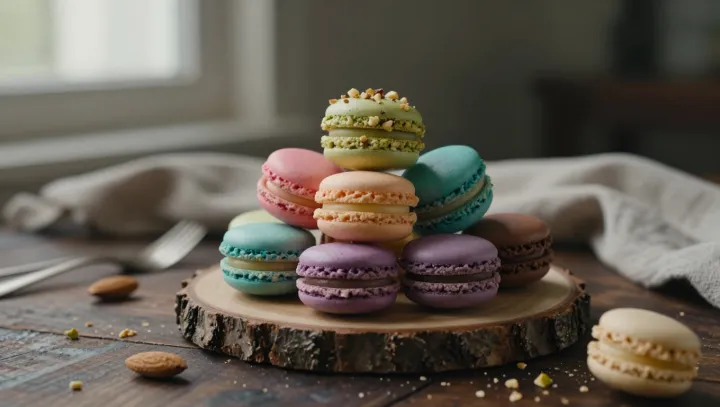
The filling came late. Long before the macaron became a confectioner's miniature sandwich, it existed as a single almond cookie, without the cream or ganache that now seems inseparable from its identity. Beneath the polished shop-window image sits a less fashionable ancestor: ground almonds, sugar and egg whites, baked without a partner.
Origins resist tidy packaging. Although the cookie is commonly associated with Italian antecedents, the familiar story that Catherine de Medici brought it to France is better treated as tradition than as settled evidence. Regional recipes offer firmer ground, since places such as Nancy still produce unfilled macarons whose rough surfaces contradict the smooth Parisian ideal. The contrast matters more than the legend: a name can survive while the thing it names changes almost beyond recognition. These were standalone cookies. Their appeal rested on almonds and texture, not on the visual drama of two matching shells enclosing a contrasting center.
The sandwich stole the show. The paired form developed much later in Parisian confectionery, and Laduree helped popularize the ganache-filled version, though claims of a single inventor deserve caution. Its construction demands discipline: meringue supplies the aerated structure, while macaronage, the controlled folding of the batter, helps determine whether shells spread correctly and develop their characteristic feet. Filling changes texture too. As moisture moves into the shells during resting, the assembled pastry becomes more tender, making the center part of the eating experience rather than mere decoration. Yet somewhere behind the glass, the solitary almond cookie remains, carrying a history its prettier descendant cannot quite conceal.