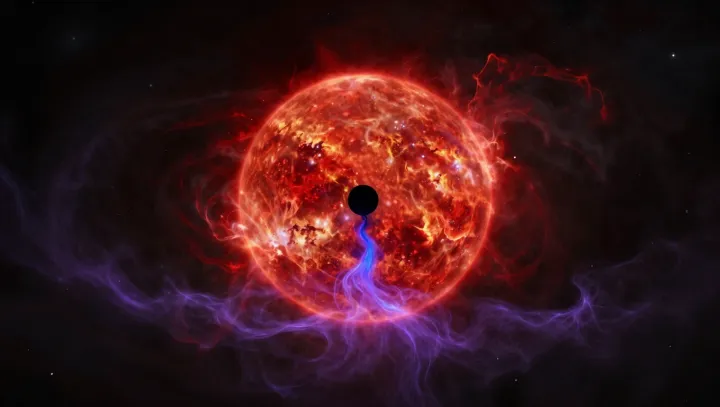
Absence is not cessation. An evaporating planet can lose gas during both Hubble observations, yet reveal escaping hydrogen in only one because the telescope measures a particular absorption signature, not the entire departing atmosphere. The apparent contradiction belongs to the measurement: how much neutral hydrogen crosses the star, at which velocities, and against what background.
Visibility is a negotiation. In Lyman-alpha spectroscopy, neutral hydrogen absorbs stellar ultraviolet light, but photoionization strips electrons from those atoms, making the resulting protons invisible to that specific diagnostic even while atmospheric escape continues. More irradiation can conceal. Depending on conditions, stronger stellar radiation can heat and drive an outflow while also shortening the lifetime of its detectable neutral component. Geometry has equal leverage. A changing stellar wind can compress or redirect the gas, while radiation pressure and charge exchange can alter its velocities and therefore where its absorption falls within the observed spectrum. These are possible mechanisms, not a diagnosis supplied by two contrasting detections alone.
A blank spectrum underdetermines. Interstellar hydrogen absorbs much of the stellar line's center, and ultraviolet emission from Earth's surroundings can contaminate it, leaving only portions available for a reliable search. Sampling also imposes limits. Different transit coverage, stellar variability, noise, or analysis choices can turn a weak signal into an upper limit rather than a detection. Evidence needs repeated visits. Comparing matched observations with stellar activity measurements and outflow models can distinguish changes in mass loss from changes in visibility. The escaping atmosphere may keep moving while its shadow slips beyond the telescope's usable light.