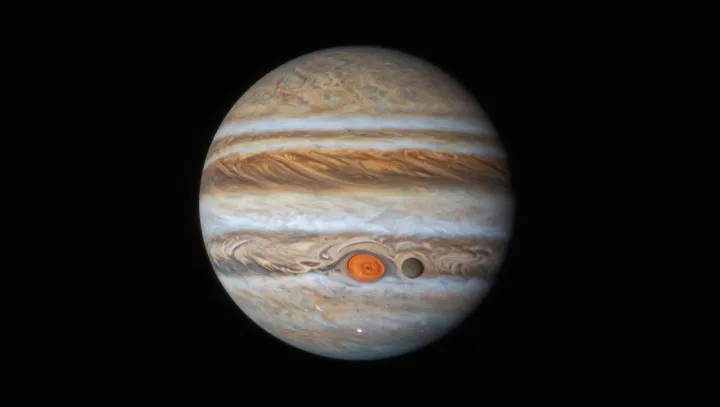
Shrinking does not mean small. Jupiter's Great Red Spot can lose an enormous amount of width and still exceed Earth's diameter, because its original scale was so much greater than our planet's. The arithmetic is simple. Measurements around 16,500 kilometers across compare with Earth's diameter of roughly 12,742 kilometers, leaving the storm wider despite its contraction.
The comparison needs care. Although saying Earth could fit inside gives readers a useful sense of scale, the Great Red Spot is an oval atmospheric vortex, not a spherical container with room for a planet. Width is not volume. Its shorter axis need not exceed Earth's diameter, so the familiar claim is best understood as a comparison across the storm's widest visible span, rather than a literal statement about enclosing Earth. Size also has layers. The visible cloud boundary does not describe every dimension of the circulation beneath it, which makes a single diameter an incomplete account of this weather system.
Persistence is the deeper puzzle. The storm is an anticyclone, a rotating region associated with high pressure, whose circulation is shaped by Jupiter's rapid rotation through the Coriolis effect and by neighboring jet streams. Its fate remains uncertain. Interactions with smaller vortices can help sustain it, while changes in surrounding winds can alter its shape, but scientists have not settled on a complete explanation for its long-term shrinkage. Contraction alone proves little. Against Jupiter's immense disk, a storm can surrender territory without surrendering its claim to dwarf the world from which it is watched.