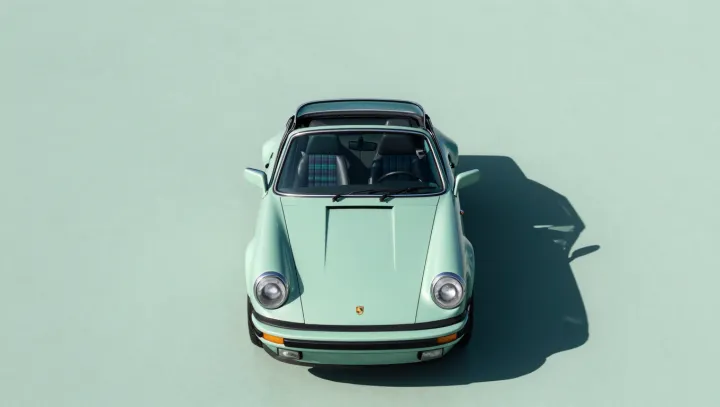
The name celebrates racing. Porsche's Targa takes its identity from the Targa Florio, the Sicilian road race where the manufacturer built a formidable record, rather than from a preexisting technical term for its roof. That distinction matters here. What sounds like an engineering classification began as a deliberate association with competition, giving an unconventional body style credentials that a description of removable panels could not.
Safety needed some glamour. Concern that American authorities might restrict conventional convertibles encouraged Porsche to develop an open car with a fixed roll bar, a removable roof panel and, initially, a folding rear window. The threat shaped development. Rollover protection was the visible engineering priority, while torsional rigidity remained a familiar challenge whenever an enclosed body surrendered part of its roof structure. Racing supplied the answer. Rather than sell the arrangement solely as a concession to possible regulation, Porsche borrowed the name of an event in which its cars repeatedly defeated larger rivals.
Success made the borrowing credible. Porsche recorded eleven overall Targa Florio victories across its participation in the race, whose demanding public-road course wound through Sicily's mountains and villages rather than around a purpose-built circuit. The roof followed later. As the model became familiar, its name entered wider automotive usage for the general arrangement of a removable roof section behind which a fixed structure remained. The reversal is revealing. A badge chosen to recall cars battling mountain bends became shorthand for the opening above a driver's head: the race survives in the space it never designed.