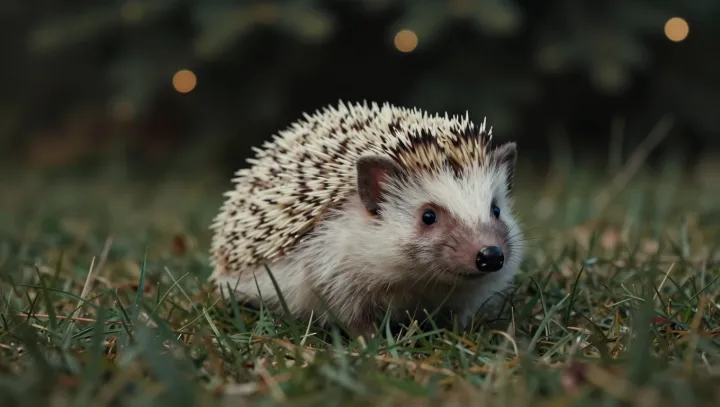
The armor needs choreography. A hedgehog's spines cannot protect its belly until muscular contractions pull its prickly coat around the parts a predator could otherwise bite. Posture supplies the protection. By drawing its head, legs and tail inward, the animal converts a back covered with modified hairs into an almost continuous barrier of points.
Hair does the hardening. Each spine consists largely of keratin, the structural protein found in ordinary hair and nails, but its hollow shaft and internal supports provide stiffness without the weight of solid material. Geometry earns its keep. A European hedgehog typically carries roughly five thousand to seven thousand spines, which remain attached rather than being fired or deliberately released at attackers. Small muscles raise them. As the skin shifts over the curling body, those raised spines face outward, leaving an approaching mouth or paw fewer routes to the soft tissue beneath.
The drawstring deserves credit. Beneath the skin, the panniculus carnosus, a sheet of skeletal muscle, works with a thickened circular band called the orbicularis panniculi to gather the spiny covering around the tucked body. Think purse, not plate. The rim tightens around the exposed underside while other muscles flex the body, producing a defensive ball rather than a rigid shell. Protection still has limits. Badgers can force hedgehogs open, and curling offers little defense against vehicles; the mechanism discourages many bites, not every threat. Inside that bristling ball, vulnerability has not disappeared; it has merely been drawn out of reach.