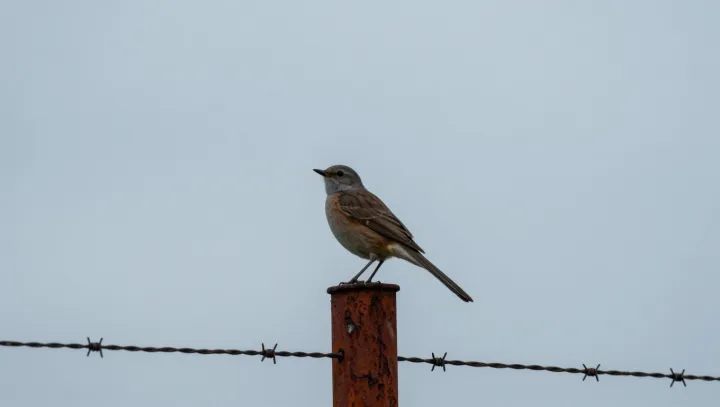
The name misleads twice. Despite its double-barrelled label, the shrike-thrush belongs neither among shrikes nor among thrushes, but in Pachycephalidae, the family that includes whistlers. Appearance makes poor genealogy. Its sturdy bill and melodious voice invite comparisons with other birds, yet those similarities do not establish the ancestry on which scientific classification depends.
Kinship demands better evidence. Shrike-thrushes belong to the genus Colluricincla, whereas true shrikes sit in Laniidae and true thrushes in Turdidae, separating three groups that everyday language has squeezed together. Names preserve first impressions. Molecular phylogenetics, which compares genetic sequences to reconstruct evolutionary relationships, offers evidence that outward resemblance alone cannot supply when ornithologists assess where a bird belongs. Similarity need not imply kinship. Shared traits can reflect common ancestry or arise independently through convergent evolution, so a familiar silhouette or musical phrase cannot, by itself, settle a question of family membership.
The bird deserves independence. The grey shrike-thrush, found across much of Australia and also in New Guinea, feeds on insects and other small animals while searching trunks, branches and the ground. Its voice rewards attention. Rich whistles and varied phrases make this woodland singer conspicuous to the ear, even when its largely grey and brown plumage draws little notice among trees. Taxonomy leaves music untouched. Filed beside the whistlers rather than either namesake, the bird carries on singing from its perch, indifferent to the two borrowed identities that follow it through human conversation.