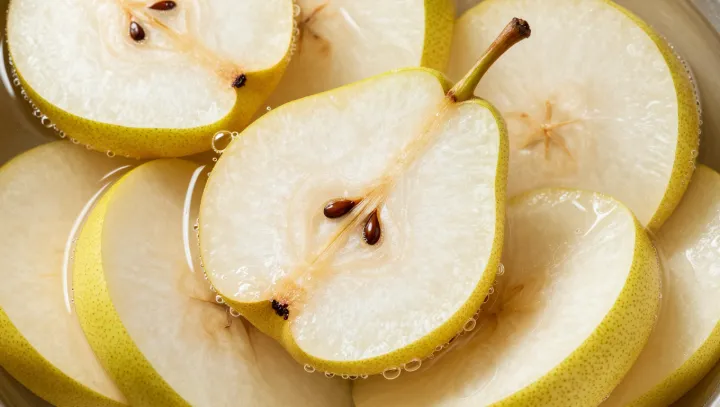
Sweetness comes with grit. Inside a juicy pear, the particles that interrupt its melting flesh are not stray sand or sugar crystals, but clusters of cells whose walls have acquired a woody reinforcement. Texture preserves that history. Botanists call these cells sclereids, and their persistence explains why sweetness and graininess can occupy the same mouthful.
The grit is structural. As the fruit develops, some cells deposit thick secondary cell walls, which become reinforced with lignin, the complex polymer that also stiffens wood. Softness takes another route. Most surrounding flesh consists of parenchyma cells, whose comparatively thin walls and water-filled interiors give the pear its yielding bite, while the hardened sclereids resist the same deformation. Reinforcement has a purpose. Sclereids belong to sclerenchyma, a supporting tissue whose tough walls provide mechanical strength and can make plant tissues harder for feeding animals to damage, although their distribution varies within a pear.
Ripeness cannot erase everything. As ripening alters pectin and other wall components in the surrounding flesh, that tissue softens, but the heavily lignified walls of stone cells do not simply dissolve with it. The contrast can sharpen. How gritty a pear feels depends on the abundance, size and clustering of its sclereids, traits influenced by genetics and growing conditions rather than sweetness alone. Graininess is no contamination. Nor is it evidence that the fruit has failed to ripen; it is a normal anatomical feature, carried into dessert by cells built for a different task. Beneath the juice, a little wood keeps its shape.