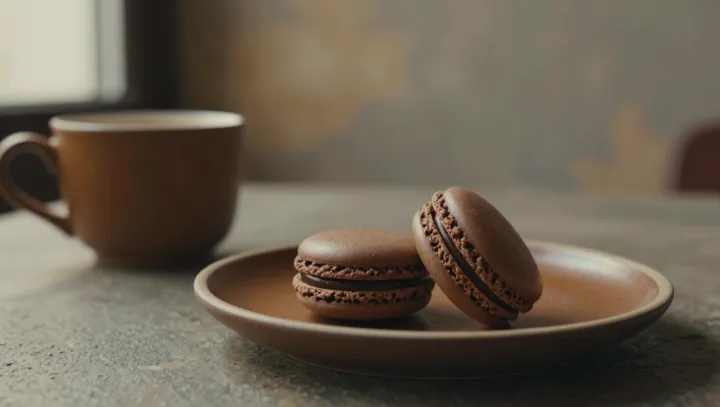
Better macarons demand restraint. Their shells depend less on adding ingredients than on folding a mixture that must become fluid without surrendering the air responsible for its lift. The bargain is delicate. Too little folding leaves a stiff batter that holds peaks; too much produces a spreading puddle before the oven can set its structure.
Stroke counts offer false comfort. Because meringue stiffness, almond flour texture and mixing technique vary, an instruction to fold a fixed number of times cannot reliably identify the same endpoint in every bowl. Movement tells more truth. Lift the spatula and watch whether batter falls in a continuous ribbon, then settles gradually into the surface rather than remaining in ridges or disappearing immediately. This is controlled deflation. Whipping causes protein denaturation and builds a foam; folding incorporates the dry ingredients and releases some trapped air, reducing the batter's apparent viscosity enough for piping.
Restraint still needs evidence. As the batter loosens, check after a few folds, scraping through the bowl and turning the mixture over rather than beating it as though more effort must mean more progress. A test dollop helps. If its peak softens while the round holds its outline, the batter is closer to readiness; rapid spreading suggests that folding has gone too far. Other variables still matter. Oven temperature, ingredient proportions and surface drying can spoil an otherwise sound batch, so folding is not a cure for every cracked shell. Leave something held inside. The neatest circle begins with air that escaped being chased away.