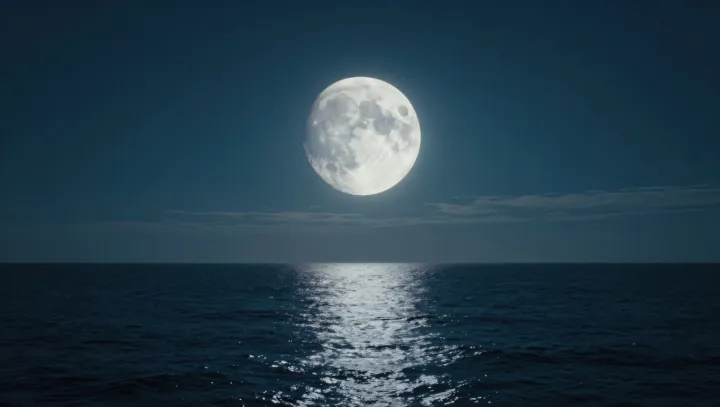
Blur need not mean darkness. A thin cloud can erase the Moon's crisp boundary while redistributing enough of its light to draw a luminous ring, because preserving an image and transmitting brightness are different optical tasks. The distinction matters overhead. What looks like a contradiction is the atmosphere separating the Moon's shape from the light that makes it visible.
The ring rewards uniformity. When moonlight encounters tiny water droplets, scattering redirects some light away from its original path, reducing contrast along the lunar edge even though much light still passes through. Diffraction supplies the pattern. Light waves scattered by each droplet interfere, reinforcing some viewing angles and weakening others, so a bright central glow can acquire surrounding colored rings called a corona. Droplet size sets scale. Smaller droplets generally produce wider coronas, while a narrow range of droplet sizes keeps their patterns aligned rather than washing them into an indistinct glow.
Not every ring qualifies. A much larger circle, roughly 22 degrees from the Moon, usually signals a halo produced by refraction through hexagonal ice crystals rather than a droplet corona. Geometry gives it away. Unlike the close-fitting corona, this halo sits far outside the lunar disk, and the cloud producing it may leave the Moon's outline relatively clear. Thinness alone proves little. The visible result depends on particle size, shape and abundance, while the Moon behind the cloud remains unchanged, its apparent border surrendered to the air.