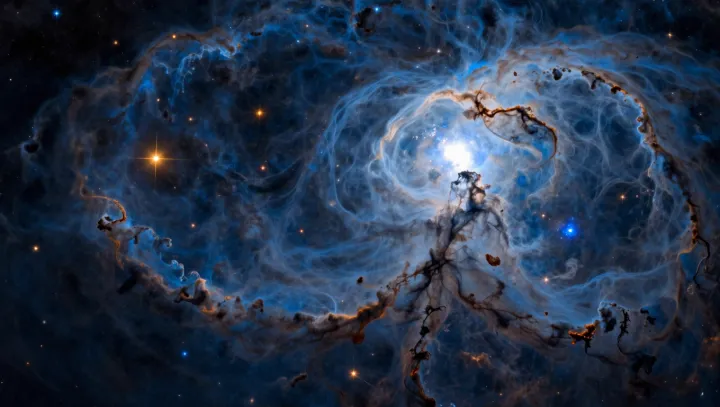
The snowflakes are impostors. In the James Webb Space Telescope's view of a dark cloud about 630 light-years away, the enormous spiked shapes belong not to interstellar matter but to the instrument's optical response to light. Their grandeur is borrowed. What appears to be celestial architecture is diffraction, made conspicuous around bright sources by the telescope's own geometry.
The hardware leaves fingerprints. Because light behaves as a wave, its passage around edges and obstructions redistributes intensity into a point-spread function, the pattern an optical system produces when imaging a point source. A star becomes more. Webb's hexagonal mirror segments contribute six prominent diffraction spikes, while the secondary mirror's support struts add features, including two fainter horizontal spikes, that help give bright stars their recognizable appearance. Nothing snowy floats there. The spikes are neither jets of expelled material nor filaments tracing the cloud, although their apparent reach can make them seem like objects with dimensions of their own.
The distinction rewards restraint. Dust in the cloud absorbs and scatters light, while Webb's infrared observations can reveal sources that are difficult to see at visible wavelengths; those astronomical signals must still be read through the instrument's optical signature. Beauty needs a footnote. Astronomers account for the point-spread function when measuring sources or assessing nearby faint features, because a bright star's redistributed light can complicate interpretation. The cloud keeps its secrets. Across its darkness, the telescope writes a geometry that belongs to the act of looking.