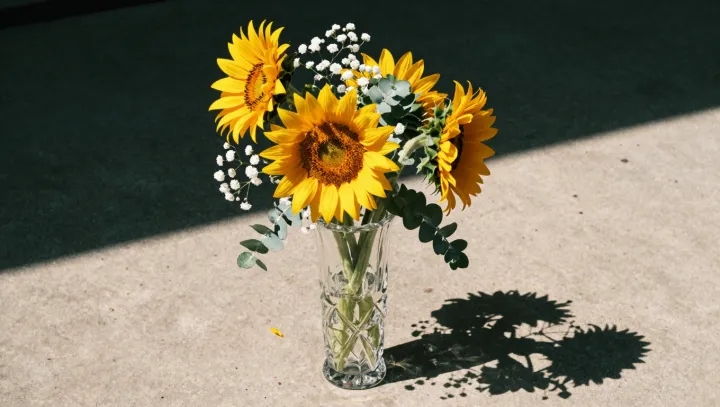
One flower is an understatement. That sunflower standing in a glass bottle carries hundreds, sometimes thousands, of individual flowers, which share a platform so neatly that the eye mistakes their gathering for a single bloom. The deception rewards closer inspection. Botanists call this flower head a capitulum, a structure that makes the familiar sunflower less a solitary specimen than a crowded address.
The center deserves attention. What looks like a textured brown surface consists of disc florets, small tubular flowers that generally contain both male and female reproductive organs, while the yellow border consists of ray florets. Those petals are flowers, too. Each familiar yellow strap is part of a separate floret's corolla, although in the common sunflower these outer florets are usually sterile and serve chiefly as an advertisement to pollinators. Reproduction belongs mostly inward. As flowering typically progresses from the rim toward the center, successive rings offer pollen and nectar to visiting insects.
The apparent simplicity is economical. By clustering flowers on one broad landing platform, the plant allows a bee to visit multiple florets without flying between separate stems, though successful seed production still depends on fertilization. Every seed has provenance. Each fertilized disc floret can develop into an achene, the dry, single-seeded fruit whose outer wall forms the familiar sunflower shell; not every floret necessarily produces one. The bottle conceals that abundance. Above its narrow neck, what seemed a single face holds a multitude, each small flower turned toward the same window.