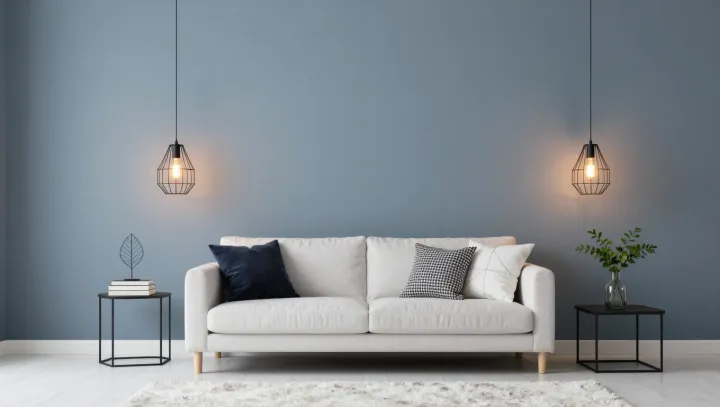
The room changes before the furniture does. In daylight, the white sofa appears crisp against the blue wall; under lamps, the same pairing can turn cool or subdued. The difference lies not in the paint alone, but in the light falling on it and the eye adjusting to its surroundings.
Daylight is no neutral backdrop. Its spectrum shifts with weather, window direction and time, yet it often supplies a broad range of wavelengths that surfaces can reflect. Artificial sources have their own spectral power distribution. A warm lamp may contain less blue light, leaving a blue wall less vivid; a cooler lamp can accentuate blue while lending the white sofa a chilly cast. Color temperature offers a clue, not a complete answer. Two bulbs with similar color temperatures can render fabrics and paint differently because their spectra differ. The color rendering index is a useful guide, though it cannot predict every hue in every room.
Placement matters as much as the bulb. Geometric pendants may concentrate light overhead, leaving the wall and patterned cushions in shadow, where colors can seem duller. A lamp aimed toward the wall, paired with softer light near the sofa, can restore depth without flooding the minimalist furnishings. Test bulbs in the room itself. Compare their color rendering and brightness, then look at the cushions, wall and upholstery together under evening light. The white sofa is not merely a surface; it is a screen on which the room quietly reveals its changing light.