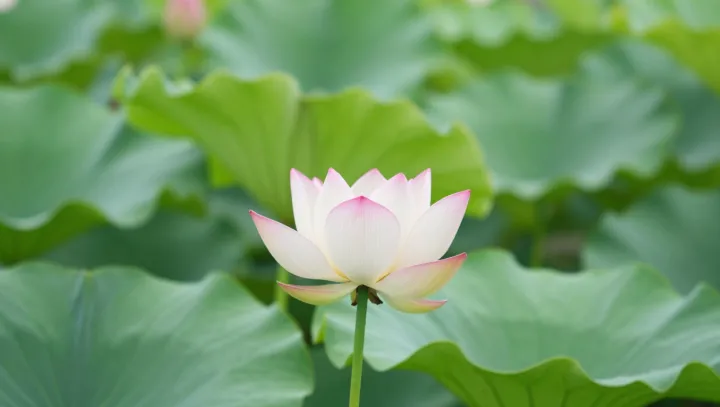
The lotus stays clean by refusing to let water settle. Its broad leaves rise above muddy ponds, yet rain beads on their surfaces and rolls away, collecting loose dirt. The trick is not a chemical detergent but an architecture so small that the eye cannot see it.
Smoothness, it turns out, is not the secret. A lotus leaf is covered with microscopic bumps coated in tiny crystals of wax. Together, these create a superhydrophobic surface: water touches only a fraction of the solid beneath it, with air trapped in the gaps. Droplets become nearly spherical. When a leaf tilts, they roll across it, picking up particles that adhere more readily to the water than to the textured surface. Scientists call this self-cleaning behavior the lotus effect. The plant also produces striking flowers and holds religious and cultural meaning in parts of Asia.
The most useful lesson for materials designers is that shape can work alongside chemistry. Researchers have imitated the leaf by combining water-repellent substances with rough surfaces in coatings for products such as exterior paints. Rain can then carry away some loose dirt, potentially reducing cleaning needs. There are limits, though. Oil, abrasion and wear can compromise a coating, and a surface that sheds water will not necessarily remove every stain. On a leaf above the pond, a bead gathers its small cargo and slips away.