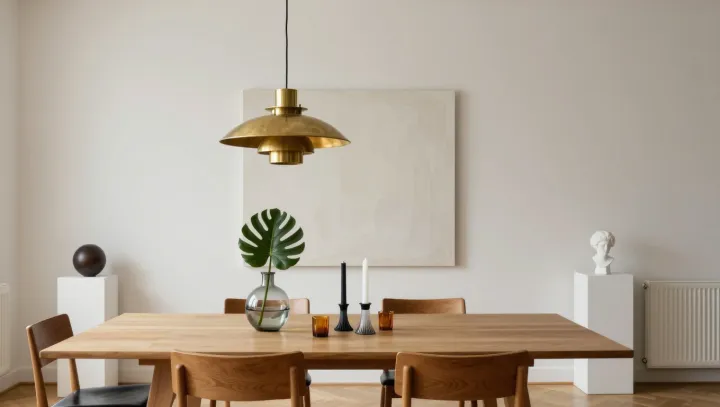
A bright pendant can make a dining table harder to see across, not easier. The culprit is often glare. When an exposed bulb sends intense light toward the eye, it can reduce contrast and make faces appear dim by comparison, even while plates and glasses are brilliantly lit.
A layered shade earns its place by controlling light, not merely by dressing up the room. Its overlapping elements can shield the bulb from direct view and soften the contrast between the fixture and its surroundings. Much depends on the material. An opaque shade directs more light toward the table, while a translucent one can spread some into the room; neither guarantees that faces receive enough light. That requires attention to vertical illuminance, the light falling on upright surfaces, as well as the light measured across the tabletop. A lamp or softly lit wall can help reveal expressions without adding another source of glare.
Proportion matters more than spectacle. A pendant roughly half to two thirds the width of the table is a useful starting point, though a visually light fixture can be larger without feeling overbearing. For a standard ceiling, the bottom of the fixture is often placed about 30 to 36 inches above the tabletop; check the view from every seat before settling on a height. Sightlines count, too. A dimmer lets the room shift from serving to conversation, but lowering output cannot fix a shade that exposes the bulb directly. At its best, the light holds the table together without placing itself between the people around it.