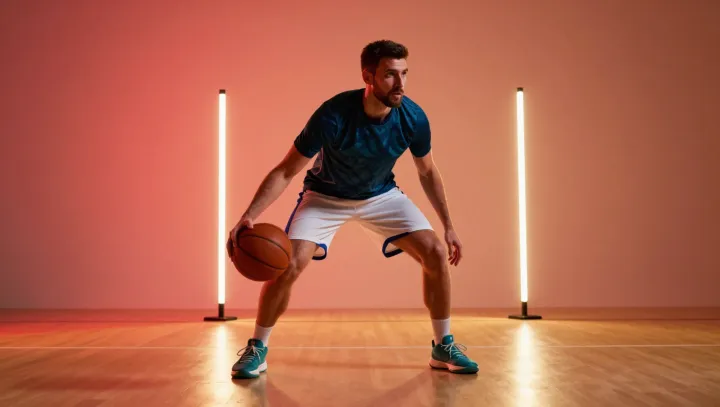
A low stance can be a trap: it makes a player harder to dislodge while quietly stealing time from the first step. Stability is not speed. With knees bent and feet apart, the player holding the ball gains a stronger position against contact, but only if that position still allows a quick departure.
The advantage is mechanical, not magical. A lower center of mass reduces the tipping effect of a shove applied above it, while a wider base of support gives the body more room to shift before its center of mass moves beyond the feet. The ball matters, too. Held close to the body with both hands, it is easier to protect from a reaching defender and less likely to pull the player off balance.
Yet the deepest crouch is rarely the best launchpad. If the feet are spread too far, the player may need to bring them back under the body before driving in a new direction; if the hips sink too low, the legs may need extra repositioning before they can apply force effectively. Movement demands useful angles. A moderate bend at the hips and knees, with weight distributed across the feet and the chest controlled, leaves more options for a pass, a dribble or a sudden cut. The ground reaction force that helps resist a shove must also be directed to propel the body where it wants to go. On the court, the stillest pose is not always the most prepared.