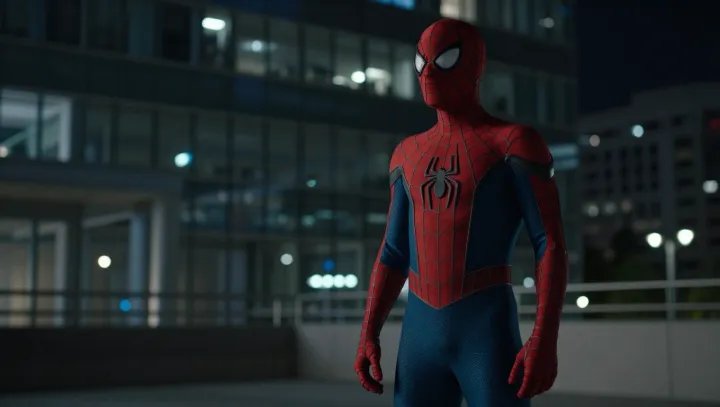
Spider-Man's mask hides a face but creates another one. Its white lenses, set against red webbing, can widen in alarm or narrow with suspicion, giving artists a shorthand for feelings that a conventional mask would conceal. The trick is not realism. It is selective exaggeration.
The lenses work best when the rest of the image joins the conversation. A steep inward angle can suggest anger; rounded shapes can read as surprise. Yet neither shape has a fixed meaning: a slumped posture might turn narrowed eyes into exhaustion rather than menace. Artists also use visual contrast to keep the lenses legible against the web pattern, while panel composition directs attention toward a glance, a gesture, or the distance between characters. The spider emblem and blue sections of the suit help anchor the figure as the pose changes.
Movement adds another layer of expression, especially on screen. Animated versions can alter lens shapes from moment to moment, while some live-action portrayals use mechanical lenses that visibly contract and expand. Comics face no such mechanical constraint: an artist can redraw the same mask differently from panel to panel, trusting readers to accept the shift as emotion rather than a change of costume. Restraint matters, too. A nearly unchanged pair of lenses, held above a motionless body, can make a moment feel more uncertain than an exaggerated reaction would. Behind the blank white shapes, silence can still look back.