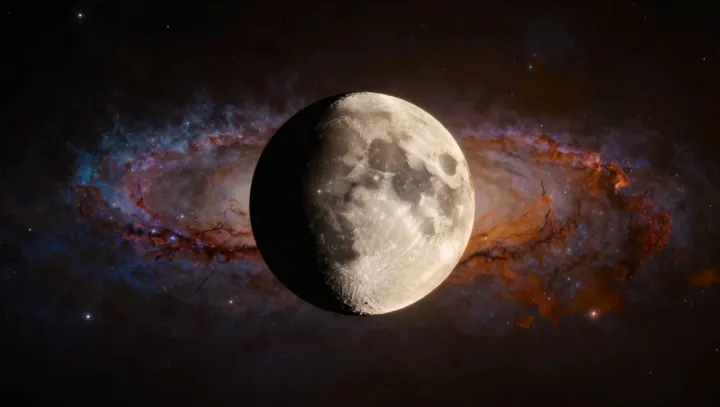
The Moon's dark plains are younger than its battered highlands, and their missing craters tell the story. Darkness is not the cause. Vast eruptions of basaltic lava flooded ancient impact basins, burying much of the older surface and leaving fresh rock exposed to a new round of collisions.
A crater count is a clock, but an imperfect one. On surfaces exposed for longer, more asteroids and smaller debris have had time to strike, leaving a denser accumulation of impact craters. The bright highlands generally carry more of these scars than the dark plains, known as maria. Their contrast records not a difference in protection from space, but a difference in when each surface was last extensively resurfaced. The older scars vanished beneath lava; later impacts left new marks on the cooled basalt. The count begins again.
Counting alone cannot supply a reliable age in years. Scientists compare craters of different sizes and use radiometric dating of returned lunar samples to calibrate the relationship between crater density and age. Even then, the method demands care: debris thrown out by a large impact can create secondary craters, and impact rates have not remained constant. Local eruptions can also produce surfaces of different ages within a single plain. The Moon keeps its history unevenly. Across its face, dark rock conceals as much as the bright scars disclose.