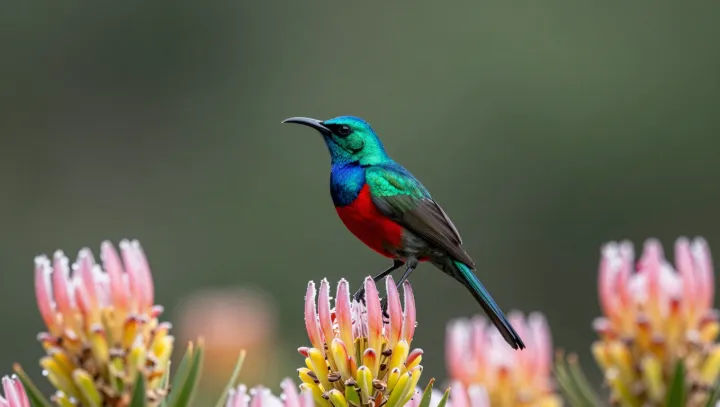
A sunbird's changing colors are a trick of light, not a change of feathers. Turn the bird, and a patch that shone green can flash blue or darken. The structures responsible stay in place; what changes is the angle at which light strikes them and reaches an observer.
The explanation lies in architecture rather than paint. In iridescent feather barbs, microscopic arrangements of keratin and pigment-containing structures called melanosomes reflect light from different layers. These reflected waves meet and undergo interference: some wavelengths reinforce one another, while others cancel. Angle changes the balance. Because the distance traveled by light through the layers depends on its direction, a different range of wavelengths can be reinforced as the bird or its viewer moves. Pigments also contribute to feather color, but pigment alone does not explain the shifting flash.
That flash is more than decoration, though its meaning depends on the species and the encounter. Male sunbirds often display iridescent plumage during courtship, and such colors may also help birds communicate with rivals or other individuals. A signal can be conspicuous from one angle and muted from another, making posture and movement part of its presentation. The effect is not a promise of mating success: light, background and the position of a potential viewer all shape what can be seen. For a bird in motion, color is a fleeting bargain between feather and sun.