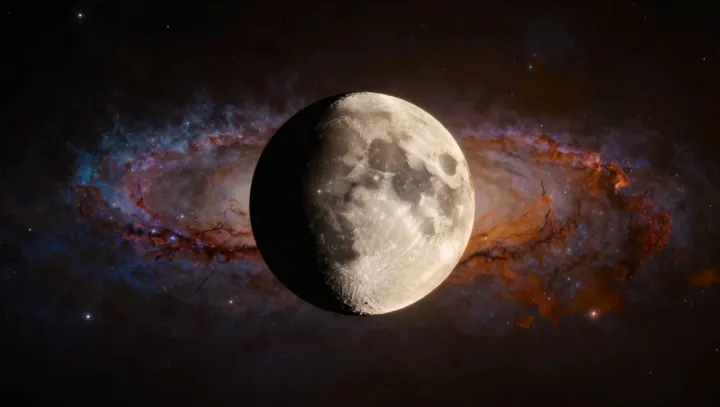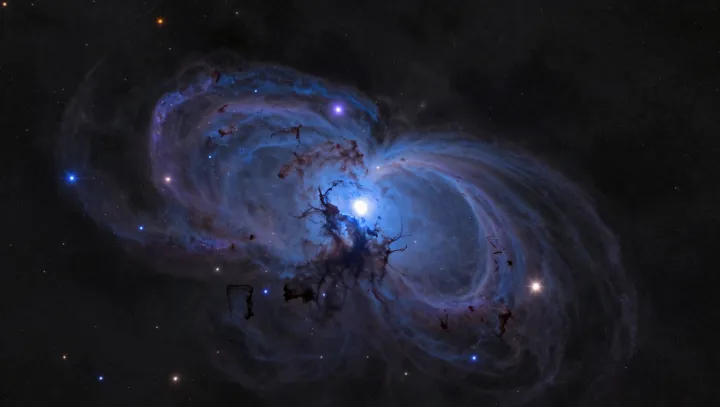
The Shark Nebula's darkness is not an absence but a condition that can help stars form. Its dust blocks visible light, while shielding molecular gas from radiation that would otherwise break molecules apart and warm the cloud. What looks like a void can shelter the raw material of stars.
Cold gives gravity an opening. Within a sufficiently dense molecular cloud, dust grains absorb radiation and emit energy at infrared wavelengths, helping the gas cool through collisions with the grains. Lower temperatures mean less thermal pressure resisting gravitational collapse. As pockets of gas become denser, gravity can draw them inward; if a collapsing core gathers enough material, a protostar may form. Dust also provides surfaces on which hydrogen atoms can combine into molecular hydrogen, a major ingredient of such clouds. Darkness alone, however, does not guarantee a stellar birth.
The shark shape is a trick of perspective, but the forces that reshape its kind are real. Some interstellar dust originates in the cool atmospheres of giant stars and later mixes with expelled gas. Massive stars can sculpt their birth clouds with energetic light and stellar winds, dispersing material even as nearby hydrogen glows red. The Shark Nebula spans about 15 light years and lies roughly 650 light years away toward Cepheus; its dark region includes Lynds Dark Nebula 1235, alongside the reflection nebulae Van den Bergh 149 and 150. In its silhouette, concealment and creation share the same dust.