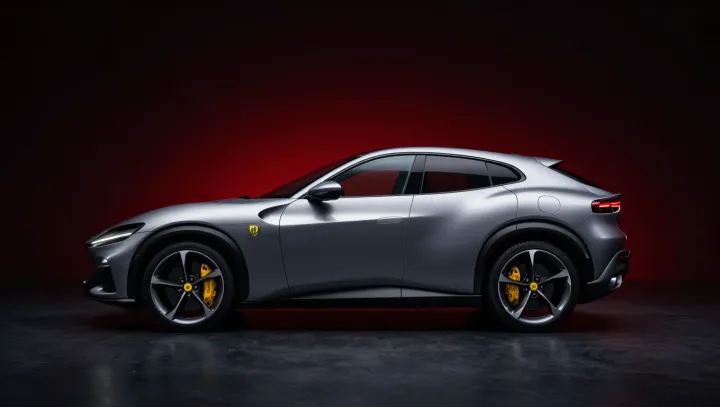
The Purosangue makes an unconventional trade: it abandons conventional anti-roll bars while asking a tall, four-door Ferrari to corner with composure. The answer is electric force. At each wheel, an actuator works with the suspension to resist the body movement that would otherwise accompany a turn.
That approach buys independence. A conventional anti-roll bar links the suspension on opposite sides of an axle, resisting their relative movement as the car leans, but that connection can also affect how the wheels respond to uneven pavement. The Purosangue instead uses electrically powered actuators integrated with its dampers. Guided by sensors and a control system, they apply forces at individual corners to counter body roll while allowing each wheel to respond to the road. The system also manages pitch during braking and acceleration; springs and dampers remain part of the suspension rather than disappearing into software.
The engineering serves an awkward ambition: a Ferrari with four doors and four seats must accommodate passengers without surrendering the responses expected of the badge. Its naturally aspirated V12 supplies the familiar mechanical argument, while the active suspension tackles the less romantic problem of controlling a heavier, taller body. There is a cost in complexity, including electric motors, sensors and control hardware, and no suspension can repeal the forces generated by mass and cornering speed. Still, the contrast is revealing. Under the long bonnet, an engine announces itself; beneath the cabin, motors work to keep that drama from spilling sideways.