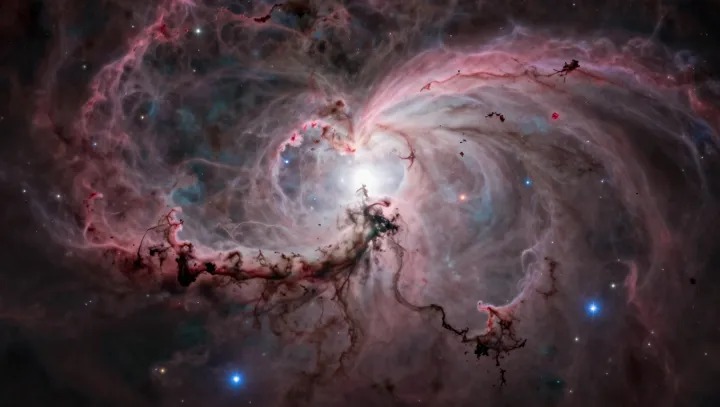
The Orion Nebula's brightest stars are also agents of destruction. Their ultraviolet radiation lights the surrounding gas, but it can strip material from the disks of gas and dust around younger stars. The glow has a cost. In this stellar nursery, the conditions that make stars visible can also shorten the time available for planets to form.
The threat is most acute close to the massive stars, especially the dominant star in Orion's Trapezium cluster. Ultraviolet photons heat the surfaces of nearby protoplanetary disks, causing gas to escape in a process called photoevaporation. Dust can be carried away too. Some exposed disks appear as bright, comet-shaped objects called proplyds, their illuminated flows pointing away from the radiation source. These are not merely pretty outlines: they are signs of material leaving the disks.
The outcome is less certain than the damage. A disk that loses gas rapidly has less time to build gas giants, while the survival of rocky planets depends on how much solid material remains and how far planet formation has progressed. Distance matters, as does shielding by surrounding gas and dust. Not every disk meets the same fate. Astronomers studying Orion can compare disks under different levels of irradiation, testing how hostile surroundings shape planetary systems. In the nebula's glare, the light that reveals a birthplace also erases some of its possibilities.